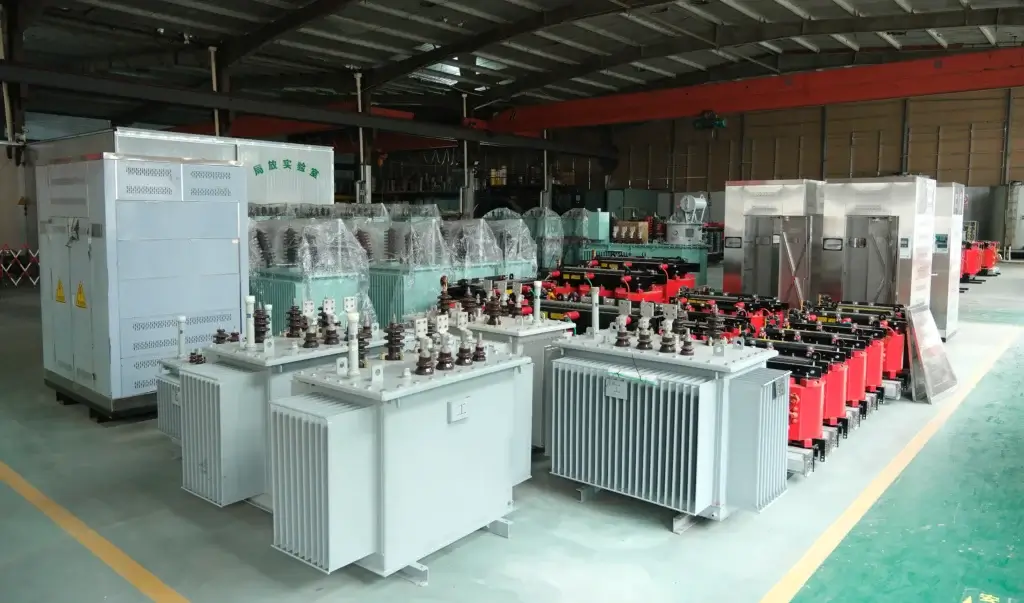
A resin dry type transformer provides voltage conversion without insulating oil. Its resin insulation system protects the windings while air removes operating heat. This construction makes it a practical option for many factories, commercial buildings, data facilities, renewable energy projects, and infrastructure installations.
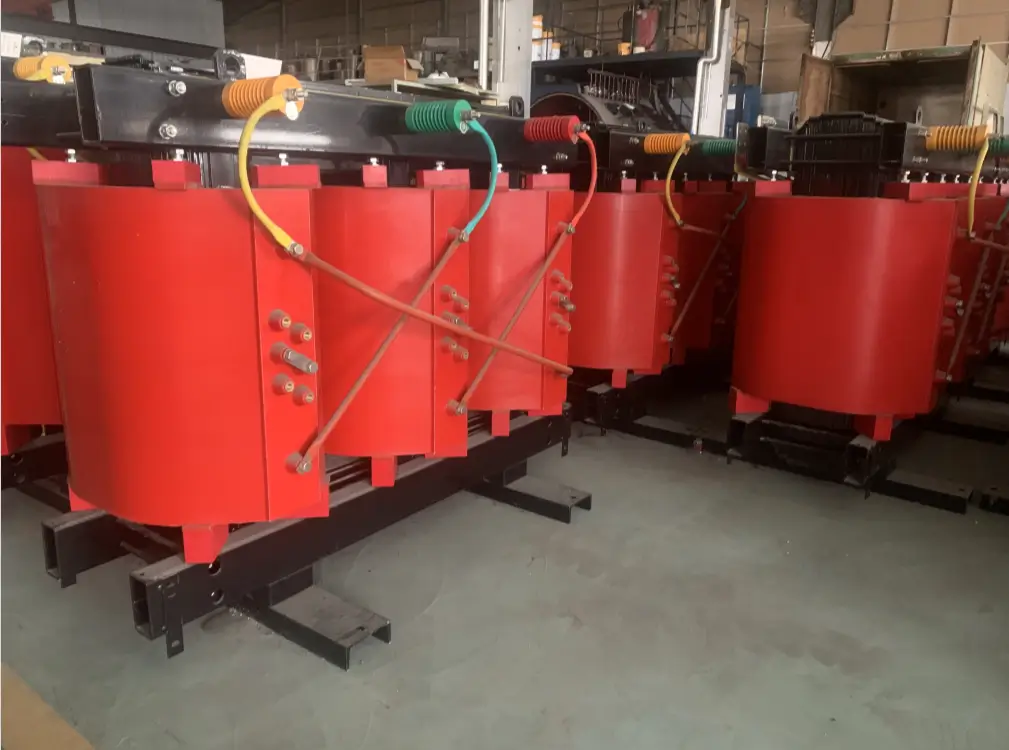
The supplied Baitong Electric workshop photo shows several red resin-insulated coil assemblies mounted on black supporting frames. Colored connection insulators, conductors, terminal points, and structural clamping components are also visible. These details help buyers understand that transformer quality depends on both insulation integrity and correct mechanical assembly.
A capable dry type transformer manufacturer should review the electrical specification and installation environment before confirming a model.
How Does a Resin Dry Type Transformer Work?
A resin dry type transformer uses solid insulation instead of transformer oil. In a common cast-resin design, selected winding components are encapsulated in resin under a controlled manufacturing process.
The resin provides electrical insulation and helps protect the winding against moisture and contamination. The transformer still requires effective airflow. Heat moves from the windings and core into the surrounding air through natural ventilation or forced-air cooling.
The main components normally include:
- Magnetic core
- High-voltage and low-voltage windings
- Resin insulation system
- Supporting and clamping structure
- High-voltage and low-voltage terminals
- Temperature sensors when specified
- Cooling fans when required
- Protective enclosure when required
- Earthing connections
Different manufacturers may use different conductor, winding, insulation, and enclosure designs. Buyers should evaluate the complete technical proposal rather than choosing by appearance alone.
Benefits and Typical Applications
A resin-insulated transformer contains no insulating oil. This removes the need to monitor oil levels or manage oil leakage from the transformer tank. It may also simplify containment planning for some indoor projects.
Typical applications include:
- Industrial production facilities
- Commercial and residential buildings
- Hospitals and public facilities
- Data and communication facilities
- Rail and transport infrastructure
- Renewable energy systems
- Indoor substations
- Locations near electrical load centers
The resin insulation can provide useful resistance to humidity and environmental contamination. However, performance still depends on the declared environmental, climatic, and fire-behavior classes.
Outdoor installation requires a suitable enclosure. The supplier must consider rain, dust, condensation, solar heating, corrosion, ventilation, and ambient temperature. A standard indoor enclosure should not be assumed to provide outdoor protection.
For projects still comparing liquid-filled and dry designs, an oil type vs dry type transformer review should consider fire planning, room layout, losses, maintenance, capacity, and lifecycle cost.
Specifications Buyers Must Confirm
Every resin dry type transformer inquiry should include clear electrical and environmental data.
Electrical Requirements
Confirm the following information:
- Rated capacity in kVA or MVA
- Primary and secondary voltage
- System frequency
- Number of phases
- Vector group
- Tapping range
- Short-circuit impedance
- Insulation level
- Temperature-rise requirements
- Guaranteed no-load and load losses
- Maximum noise requirement when applicable
- Load profile and harmonic conditions
Motor loads, variable-frequency drives, rectifiers, and other nonlinear equipment may affect transformer design. Inform the supplier when these loads form a significant part of the system.
Cooling and Enclosure
Confirm whether the transformer will use natural-air cooling or additional fans. Fans may provide extra capacity under defined conditions, but they also require controls, power, inspection, and maintenance.
The enclosure must allow enough airflow while meeting the required protection level. Installing a transformer in a small room or against a wall can restrict cooling.
The supplier needs the following site information:
- Indoor or outdoor installation
- Maximum and minimum ambient temperature
- Installation altitude
- Humidity and condensation conditions
- Dust or chemical contamination
- Available ventilation
- Required enclosure protection
- Cable-entry direction
- Space and access restrictions
Efficiency and Losses
Do not compare transformers only by purchase price. No-load loss continues whenever the transformer is energized. Load loss changes with the current passing through the windings.
Buyers should compare guaranteed losses at the required rating and temperature. Projects entering the US market should also review applicable categories, test procedures, and current requirements in the U.S. Department of Energy distribution transformer resources.
Manufacturing, Testing, and Supplier Evaluation
Reliable resin insulation requires controlled materials and production conditions. Winding alignment, conductor preparation, mold condition, resin processing, curing, terminal assembly, and mechanical clamping can all influence the finished transformer.
Voids, contamination, poor curing, or excessive mechanical stress may reduce insulation reliability. For this reason, process control is as important as final appearance.
The photo supplied for this article shows smooth red winding surfaces, multiple terminal points, colored connection insulators, linking conductors, and supporting frames. It does not by itself prove electrical performance. Buyers should therefore request technical documentation and test records.
Useful documents include:
- Approved technical data sheet
- General arrangement drawing
- Nameplate drawing
- Terminal arrangement
- Enclosure drawing
- Accessory list
- Routine test report
- Installation and maintenance manual
- Packing and transportation plan
Relevant testing may include winding resistance, voltage ratio, vector-group verification, no-load loss, load loss, impedance, applied-voltage testing, induced-voltage testing, and partial discharge measurement when required.
For dry-type transformer scope, environmental classes, enclosure considerations, dielectric features, thermal performance, and test requirements, procurement teams can review IEC 60076-11 dry-type transformer requirements. The purchase contract should state the required standard, edition, and project-specific acceptance criteria.
Before ordering a resin dry type transformer, ask the supplier to confirm:
- Which winding and resin process will be used?
- Which losses and impedance values are guaranteed?
- Which routine tests are included?
- Is partial discharge measurement required?
- What enclosure and cooling method are proposed?
- Which temperature sensors and fan controls are included?
- How will the transformer be protected during shipment?
- What ventilation and clearance conditions are required on site?
A complete technical review reduces the risk of choosing a transformer that fits the electrical rating but not the installation environment.
Frequently Asked Questions
Is a resin dry-type transformer suitable for outdoor installation?
It can be used outdoors when the enclosure, ventilation, condensation protection, coating, and accessories are designed for the site conditions. An indoor unit should not be placed outdoors without suitable protection.
Does a dry-type transformer require maintenance?
Yes. Maintenance may include cleaning ventilation paths, inspecting connections, checking fans and temperature controls, and examining insulation surfaces for contamination or damage.
What information is needed for a quotation?
Provide capacity, voltage, frequency, vector group, tapping range, impedance, loss requirements, installation conditions, enclosure level, cooling method, accessories, quantity, and applicable standard.