The oil type vs dry type transformer decision affects installation layout, fire protection, maintenance planning, operating cost, and long-term reliability. Neither design is automatically better for every project. The correct choice depends on the load, voltage class, installation environment, local regulations, and available maintenance resources.
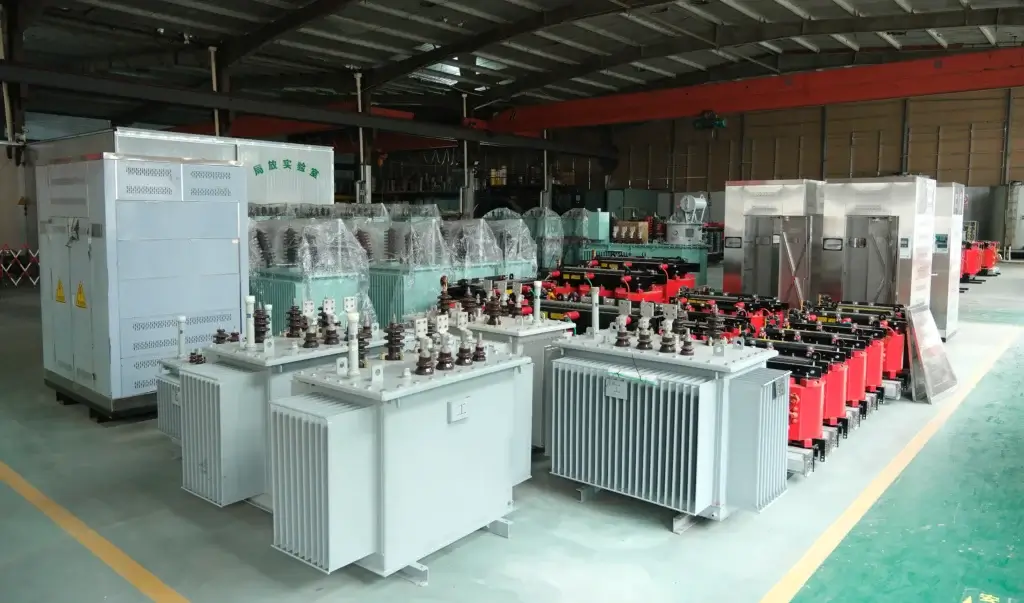
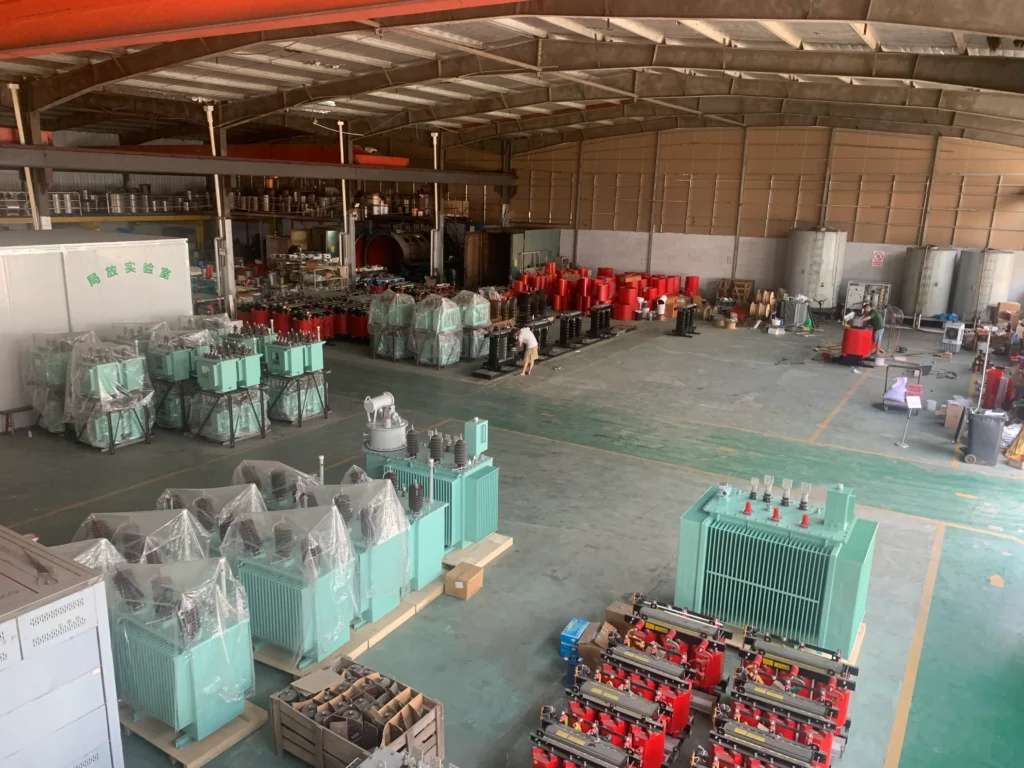
In the Baitong Electric workshop photo supplied with this article, green corrugated-tank oil-immersed units are visible beside red dry-type coil assemblies. The workshop also includes an area marked as a partial discharge laboratory. This combination reflects an important purchasing principle: buyers should compare both transformer designs under the same project requirements.
How the Two Transformer Designs Work
An oil-immersed transformer uses insulating liquid around its core and windings. The liquid provides electrical insulation and transfers heat to the tank walls, corrugated panels, or radiators.
Oil-filled designs are widely used in outdoor distribution systems, industrial facilities, renewable energy projects, and utility substations. Effective liquid cooling can support compact construction and demanding load conditions.
A dry-type transformer does not use insulating oil. Its windings may use cast resin, vacuum pressure impregnation, or another solid insulation system. Heat is transferred to the surrounding air through natural or forced ventilation.
Dry-type units are often selected for buildings, factories, data facilities, hospitals, transport projects, and other locations where indoor installation or liquid containment is a major concern. Outdoor use is also possible when a suitable enclosure and environmental protection system are specified.
Oil Type vs Dry Type Transformer Comparison
A practical oil type vs dry type transformer comparison should cover the complete installation, not only the transformer purchase price.
| Selection factor | Oil-immersed design | Dry-type design |
|---|---|---|
| Insulation and cooling | Insulating liquid cools and insulates the active part | Solid insulation and air provide insulation and cooling |
| Common installation | Often used outdoors or in dedicated transformer rooms | Common indoors and near load centers |
| Fire and spill planning | Requires evaluation of liquid containment and fire protection | No insulating-oil spill risk, but ventilation and fire rules still apply |
| Maintenance | Oil condition, seals, gaskets, valves, and leakage require attention | Ventilation paths, dust, connections, temperature, and insulation surfaces require attention |
| Space | Efficient liquid cooling may support a compact design | Required clearances and enclosure can increase installation space |
| Environmental exposure | Tank coating, sealing, bushings, and accessories must suit the site | Enclosure protection, humidity control, and ventilation must suit the site |
| Initial cost | Depends on rating, materials, accessories, and specification | Depends on insulation system, enclosure, cooling, and specification |
| Operating cost | Determined by actual no-load and load losses | Also determined by actual no-load and load losses |
Efficiency should be evaluated from guaranteed loss values rather than general assumptions. Buyers supplying the US market can review the applicable categories and test requirements in the U.S. Department of Energy distribution transformer resources. The DOE addresses liquid-immersed, low-voltage dry-type, and medium-voltage dry-type distribution transformers separately.
When Is an Oil-Immersed Transformer the Better Choice?
An oil-immersed unit is often practical when the transformer will be installed outdoors, when higher capacity is required, or when the project needs effective heat transfer within a controlled footprint.
Important purchasing checks include:
- Rated capacity and expected load profile
- Primary and secondary voltage
- System frequency and number of phases
- Vector group and tapping range
- Guaranteed no-load and load losses
- Impedance and temperature rise
- Cooling method
- Insulating-liquid specification
- Tank structure and corrosion protection
- Bushings, indicators, valves, relays, and protection accessories
- Transport dimensions and total weight
Buyers should ask an oil immersed transformer manufacturer how the active part is dried, how the tank is inspected, and how the filling process is controlled. Tank welding, gasket selection, oil cleanliness, sealing, and final inspection all influence field reliability.
The project should also define oil containment and fire-safety requirements before the equipment room or outdoor foundation is completed. Local rules may affect spacing, barriers, drainage, and protection systems.
When Is a Dry-Type Transformer the Better Choice?
A dry-type unit is often preferred when the transformer must be installed inside a building or close to the electrical load. It can also be useful where liquid containment is difficult.
The buyer should confirm:
- Cast-resin, impregnated, or other insulation design
- Insulation and temperature-rise class
- Natural-air or forced-air cooling
- Required enclosure protection level
- Ventilation space around the transformer
- Ambient temperature and altitude
- Humidity, dust, salt, and contamination conditions
- Noise requirements
- Thermal monitoring accessories
- Cable entry and termination arrangement
A qualified dry type transformer manufacturer should review the actual room layout. Restricted airflow can increase operating temperature, even when the transformer itself has been correctly designed.
Dry-type transformers also require maintenance. Dust should not block cooling paths, electrical connections must remain secure, and ventilation equipment should be inspected when fans are fitted.
For ratings, connection symbols, transport considerations, liquid-preservation systems, and general test requirements, procurement teams can refer to IEC 60076-1 power transformer requirements. The purchase specification should identify the exact standard and edition required by the project.
Before finalizing an oil type vs dry type transformer specification, request an approved technical data sheet, general arrangement drawing, accessory list, nameplate drawing, and routine test report format. Test requirements may include winding resistance, voltage ratio, insulation checks, no-load loss, load loss, impedance, and other agreed items. Partial discharge requirements should be stated when applicable to the transformer design and project standard.
The best oil type vs dry type transformer choice is the one that fits the complete electrical system and installation environment. Buyers should compare safety, losses, maintenance, room design, accessories, transportation, and lifecycle cost before approving a supplier.
Frequently Asked Questions
Is a dry-type transformer always safer indoors?
It avoids insulating-oil leakage, which can simplify some indoor projects. However, ventilation, clearances, enclosure design, temperature monitoring, and local fire rules still require careful review.
Which transformer requires less maintenance?
The maintenance tasks are different. Oil-filled units require attention to liquid condition and sealing components. Dry-type units require clean ventilation paths, secure connections, and inspection of insulation surfaces.
Which design is more energy efficient?
Efficiency depends on the core, conductors, rated capacity, loading profile, temperature, and guaranteed loss values. Compare supplier test data and applicable efficiency regulations instead of relying only on transformer type.