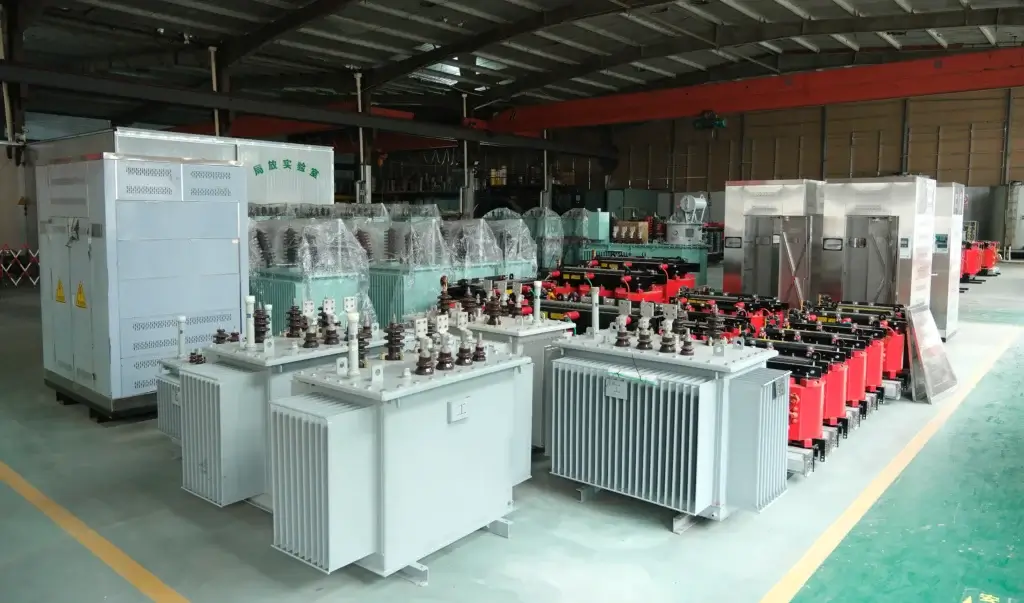
Medium dry type transformers provide voltage conversion without using transformer oil as the cooling or insulating medium. They are commonly considered for commercial buildings, factories, data facilities, renewable-energy systems, transportation projects, and indoor substations.
Selecting the correct transformer requires more than matching the primary and secondary voltages. Buyers must also confirm capacity, vector group, impedance, insulation level, losses, temperature rise, cooling, enclosure, and site conditions. An experienced dry type transformer manufacturer can review these requirements before production begins.
What Are Medium Dry Type Transformers?
The more common industry term is “medium-voltage dry-type transformers.” These transformers have at least one winding operating within the project’s medium-voltage system and do not use insulating liquid.
Cast-resin designs use solid resin insulation around the windings. The insulation supports dielectric performance and protects the winding against environmental exposure. Air circulates around the transformer to remove heat.
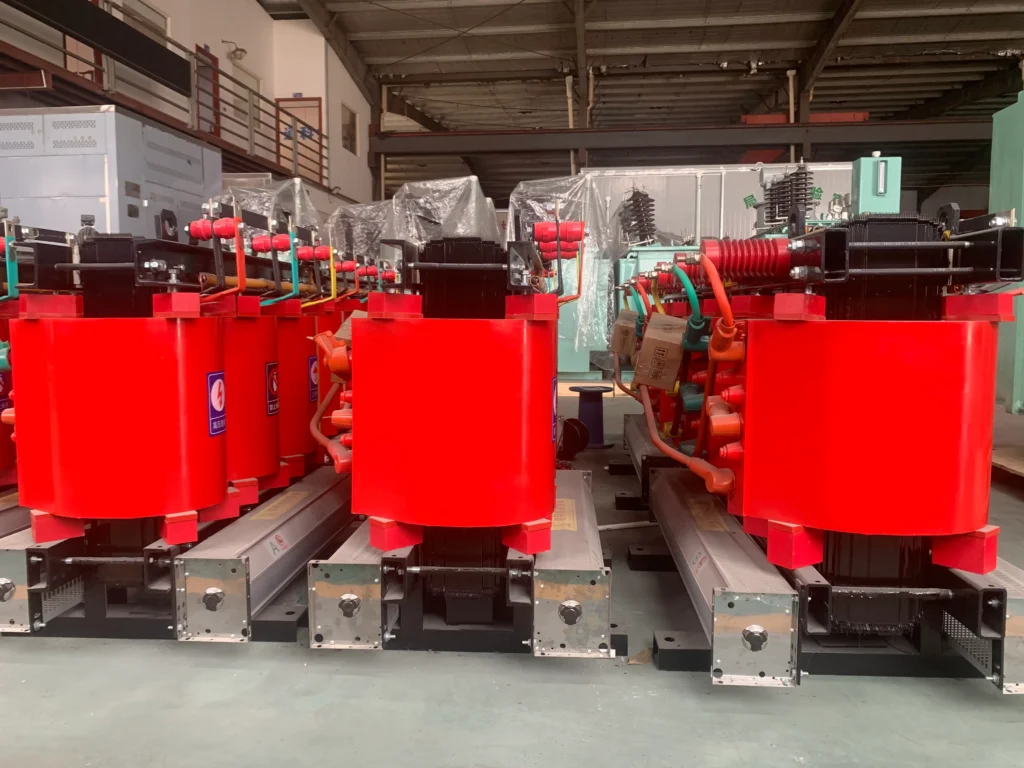
The factory photograph shows several three-phase dry-type transformer assemblies. Visible details include red resin-insulated windings, phase connections, insulated terminals, steel support frames, core structures, warning labels, and bottom-mounted cross-flow fans.
The units are pictured without complete outer enclosures. This makes the active construction visible, but the photograph does not provide enough information to verify capacity, voltage ratio, insulation class, losses, or protection level.
Medium dry type transformers may be supplied as open assemblies or installed inside ventilated protective enclosures. The correct configuration depends on accessibility, contamination, ventilation, fire requirements, and the installation environment.
Where Are Dry-Type Transformers Used?
Dry-type transformers are often selected for indoor locations where buyers want to avoid an oil-filled tank and associated oil-containment arrangements.
Typical applications include:
- Commercial and residential developments
- Manufacturing plants
- Hospitals and data facilities
- Metro and railway infrastructure
- Solar and wind power projects
- Water-treatment facilities
- Indoor distribution rooms
- Compact substations
- Marine and offshore projects with suitable specifications
Application alone does not determine the correct design. A clean electrical room has different requirements from a dusty factory, humid coastal location, high-altitude site, or outdoor substation.
The installation area must provide suitable clearances and ventilation. Air inlets and outlets should not be blocked. Where cooling fans are specified, maintenance personnel need safe access for inspection and replacement.
Specifications to Confirm Before Ordering
A complete specification helps the manufacturer prepare an accurate technical proposal and quotation.
Electrical Requirements
Provide the following information:
- Rated capacity in kVA or MVA
- Primary and secondary voltages
- Frequency
- Number of phases
- Vector group
- Percentage impedance
- Tapping range
- Insulation level
- Required no-load and load losses
- Temperature-rise limit
Capacity should reflect the expected operating load, future load growth, harmonics, motor starting, and other project conditions. Oversizing can increase purchase cost and no-load losses. Undersizing can create excessive temperature and reduce operating reliability.
Environmental Conditions
State the maximum and minimum ambient temperatures, altitude, humidity, contamination level, ventilation conditions, and seismic requirements.
These details influence insulation clearances, thermal performance, enclosure selection, and accessory requirements. IEC 60076-11 for dry-type transformers covers areas including dielectric and thermal performance, altitude, environmental classes, climatic classes, fire behaviour, and enclosure management.
The final order should identify the required standard and edition. Local regulations, utility requirements, or project specifications may add further conditions.
Cooling and Enclosure
Confirm whether the transformer will operate with natural-air cooling or use forced-air fans. Fans may support a defined additional loading capability when this is included in the approved transformer design. Buyers should not assume a fan rating without checking the technical data sheet.
If an enclosure is needed, specify:
- Required protection level
- Indoor or outdoor location
- Enclosure material and coating
- Ventilation arrangement
- Cable-entry direction
- Terminal positions
- Access panels
- Overall dimensional limits
The enclosure affects cooling. Its design must be coordinated with the transformer’s loss and temperature-rise calculations.
Manufacturing and Routine Testing
Medium dry type transformers require control throughout material preparation, winding production, resin processing, active-part assembly, connections, and final testing.
During assembly, the manufacturer should inspect winding surfaces, insulation distances, supports, connections, fasteners, phase markings, grounding points, sensors, and cooling equipment. Any enclosure should also be checked for dimensions, ventilation, doors, locks, and cable-entry provisions.
Applicable routine tests may include:
- Winding resistance measurement
- Voltage-ratio measurement
- Vector-group verification
- No-load loss and current measurement
- Load loss and impedance measurement
- Insulation tests
- Functional inspection of sensors and cooling fans
Buyers should request the agreed test report before shipment. Special or witnessed tests must be stated before production because they can affect both price and delivery time.
Energy-efficiency requirements depend on the destination and transformer classification. Projects entering the United States should review the applicable U.S. Department of Energy distribution transformer requirements when establishing guaranteed loss values.
How to Request an Accurate Quotation
When requesting medium dry type transformers, send the manufacturer a technical specification, single-line diagram, equipment schedule, or previous transformer nameplate.
The inquiry should include:
- Electrical ratings and quantity
- Installation location and conditions
- Cooling requirements
- Enclosure and cable-entry details
- Accessories and monitoring functions
- Applicable technical standard
- Required testing
- Documentation language
- Packing requirements
- Destination and delivery terms
Ask the supplier to submit a completed technical data sheet and dimensional drawing. Review deviations carefully before approving the order.
Price comparisons should use the same scope. One offer may exclude the enclosure, fans, temperature controller, special tests, surge protection, shipping packaging, or required documentation.
Well-specified medium dry type transformers are easier to manufacture, install, commission, and maintain. Clear technical communication at the inquiry stage reduces design revisions and unexpected site changes.
Frequently Asked Questions
Are dry-type transformers only used indoors?
No. Indoor installation is common, but outdoor use may be possible with a properly designed enclosure and suitable environmental specification.
Do all dry-type transformers need cooling fans?
No. Many operate with natural-air cooling. Fans are added when required by the approved thermal design or loading requirement.
What information is needed for a quotation?
Provide capacity, voltage ratio, phases, frequency, vector group, impedance, tapping range, losses, installation conditions, enclosure, cooling, accessories, standard, quantity, and destination.