Choosing among oil immersed transformer manufacturers requires more than comparing prices and delivery times. A transformer must match the electrical system, operating environment, efficiency target, installation layout, and local technical requirements.
Buyers should evaluate engineering capability, manufacturing control, oil processing, routine testing, documentation, and communication. An experienced oil immersed transformer manufacturer should review these points before confirming the final design and quotation.
What Should a Reliable Manufacturer Provide?
A qualified supplier should first understand the application. A factory cannot prepare an accurate proposal from the capacity alone.
The initial technical review should cover:
- Rated capacity in kVA or MVA
- Primary and secondary voltages
- Frequency and number of phases
- Vector group
- Percentage impedance
- Tapping range
- Insulation level
- Cooling method
- Loss and temperature-rise limits
- Indoor or outdoor installation
- Ambient temperature and altitude
- Required accessories
- Applicable technical standard
Oil immersed transformer manufacturers should also identify missing or conflicting information. For example, the requested terminal arrangement may not fit the available installation space. A high-altitude site may require changes to insulation clearances or cooling performance.
Buyers should provide a single-line diagram, technical specification, previous transformer nameplate, or expected load data whenever possible. This reduces assumptions and helps the supplier prepare a comparable offer.
Engineering, Materials, and Tank Construction
The transformer design must coordinate the core, windings, insulation system, tank, oil, bushings, tap changer, and accessories.
Buyers should ask the manufacturer to state the proposed conductor material, core material, oil type, cooling designation, tank arrangement, corrosion-protection method, and accessory scope. These details should appear in the technical data sheet or approved drawings.
The purchase specification should also identify the applicable transformer standard. IEC 60076-1 for power transformers addresses general requirements such as ratings, connection symbols, transport, liquid-preservation systems, tank tests, and condition-monitoring provisions.
Tank quality deserves special attention. The supplier should control plate preparation, welding, surface treatment, sealing surfaces, and final coating. The finished tank must withstand the conditions defined by its design without unacceptable leakage or deformation.
Bushings and terminals must match the system voltage, conductor arrangement, and connection method. Buyers should confirm whether cables, busbars, cable boxes, or exposed terminals will be used.
Manufacturing, Oil Processing, and Testing
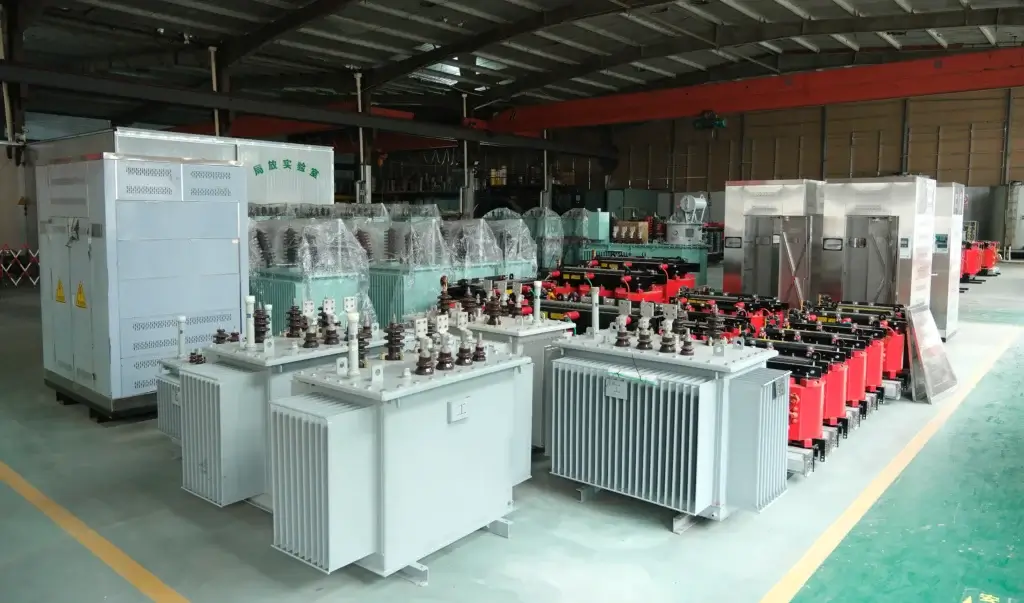
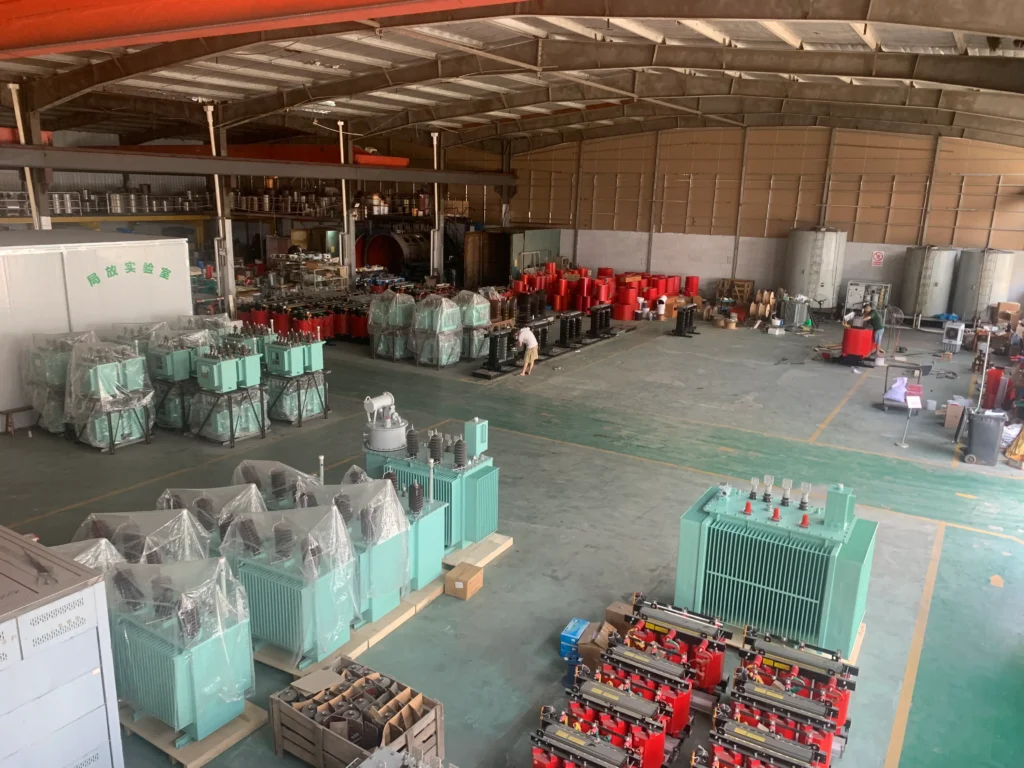
The supplied factory photograph shows a large transformer workshop containing multiple green oil-immersed transformers, red dry-type transformer windings, assembly areas, stored components, and personnel working on equipment. Some transformers are protected with plastic coverings, while completed oil-filled units have visible cooling fins and top-mounted bushings.
The image provides useful evidence of transformer production activity. However, production capacity, voltage ratings, certifications, and test results cannot be determined from the photograph alone. Buyers should verify these items through documents and project-specific records.
Important manufacturing stages include:
- Core preparation and stacking
- Coil winding
- Insulation preparation
- Active-part assembly
- Drying
- Tank fabrication and inspection
- Oil treatment and filling
- Final assembly
- Routine testing
- Packing and shipment inspection
Insulating oil performs both dielectric and heat-transfer functions. Its specification must match the transformer design and purchase contract. IEC 60296 for mineral insulating oils provides specifications and test methods for mineral oils intended for transformers and similar electrical equipment.
Buyers can also review BTCN Electric’s transformer oil filling process to understand why moisture control, oil treatment, filling, sealing, and leakage inspection matter.
Before shipment, oil immersed transformer manufacturers should provide the agreed routine test documentation. Depending on the specification, tests may include:
- Winding resistance
- Voltage ratio
- Vector-group verification
- No-load current and no-load loss
- Load loss and impedance
- Insulation tests
- Functional checks of accessories
- Oil testing when required
The buyer should confirm the test scope before production. Witness testing, special tests, or third-party inspection may require additional scheduling and cost.
How to Compare Quotations and Factory Support
Two transformer quotations are only comparable when their technical scope is the same. A lower price may exclude important accessories, testing, documentation, packaging, or loss requirements.
Create a comparison sheet covering:
- Electrical ratings
- Guaranteed losses
- Temperature rise
- Core and winding materials
- Oil specification
- Tank and cooling arrangement
- Bushings and terminals
- Tap changer
- Protection and monitoring accessories
- Testing scope
- Spare parts
- Drawings and reports
- Packing method
- Delivery terms
- Warranty terms
Communication quality is also important. The supplier should respond clearly to engineering questions and record revisions in the technical documents. Verbal statements should be added to the approved specification before the order is released.
For export projects, ask about packing dimensions, total weight, lifting points, moisture protection, spare parts, shipping marks, and document format. The receiving team should have enough information to unload, store, install, and commission the unit safely.
Good oil immersed transformer manufacturers do not simply offer a standard model. They help the buyer identify technical risks before those risks become production changes or site problems.
Frequently Asked Questions
What information should I send to a transformer manufacturer?
Send the capacity, voltage ratio, frequency, phases, vector group, impedance, tapping range, installation conditions, efficiency requirements, accessories, applicable standard, quantity, and destination.
How can I verify a manufacturer’s quality?
Review its technical proposal, drawings, material specifications, production process, test scope, sample test reports, factory photographs, quality records, and references relevant to your project.
Should I choose the lowest transformer quotation?
Not automatically. Compare the complete technical scope, guaranteed losses, materials, accessories, testing, documentation, packing, delivery terms, and after-sales support before evaluating price.
Selecting between oil immersed transformer manufacturers should be a technical and commercial process. A complete specification, documented factory controls, appropriate testing, and clear communication provide a stronger basis for a reliable transformer purchase.