Finding a reliable dry-type transformer supplier is a critical decision for industrial engineers, grid contractors, and commercial project managers. Power distribution systems require maximum safety, high energy efficiency, and long-term durability. A single transformer failure can lead to expensive downtime, site hazards, or grid instability.
At Baitong Electric, we manufacture medium and high-voltage power equipment inside our modern production facility. In this insider guide, we explain how top-tier manufacturers build cast resin transformers. We will share the exact quality metrics you should evaluate before choosing your next dry-type transformer supplier.
Why Quality Standards Matter for Dry-Type Transformers
Dry-type transformers operate without flammable liquid coolants. Instead, they rely on air circulation and specialized solid insulation systems. Because of this design, they are ideal for indoor installations, hospitals, subways, and data centers. Fire safety remains their biggest advantage over oil-immersed units.
However, dry-type units demand extreme precision during manufacturing. Minor air bubbles in the resin winding can cause severe electrical breakdown over time. High-quality production requires strict compliance with international manufacturing benchmarks such as the IEC 60076-11 standard.
When you evaluate a potential dry-type transformer supplier, always verify their core insulation technology. Leading factories use Vacuum Pressure Impregnation (VPI) or Epoxy Resin Vacuum Casting. Cast resin transformers offer superior mechanical strength and excellent resistance to moisture and dust.
Inside Our Workshop: Crucial Manufacturing & Quality Steps
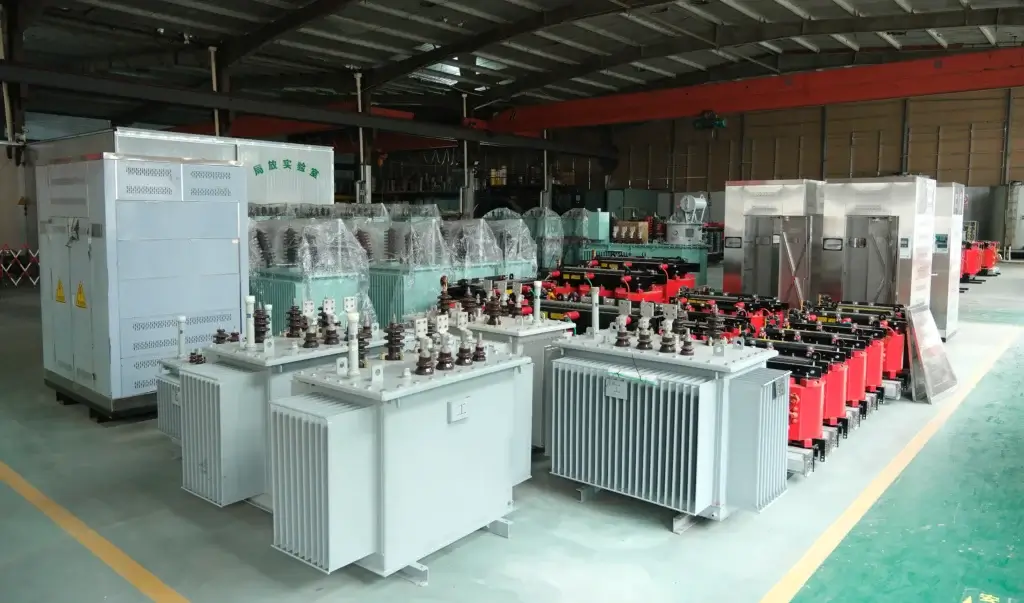
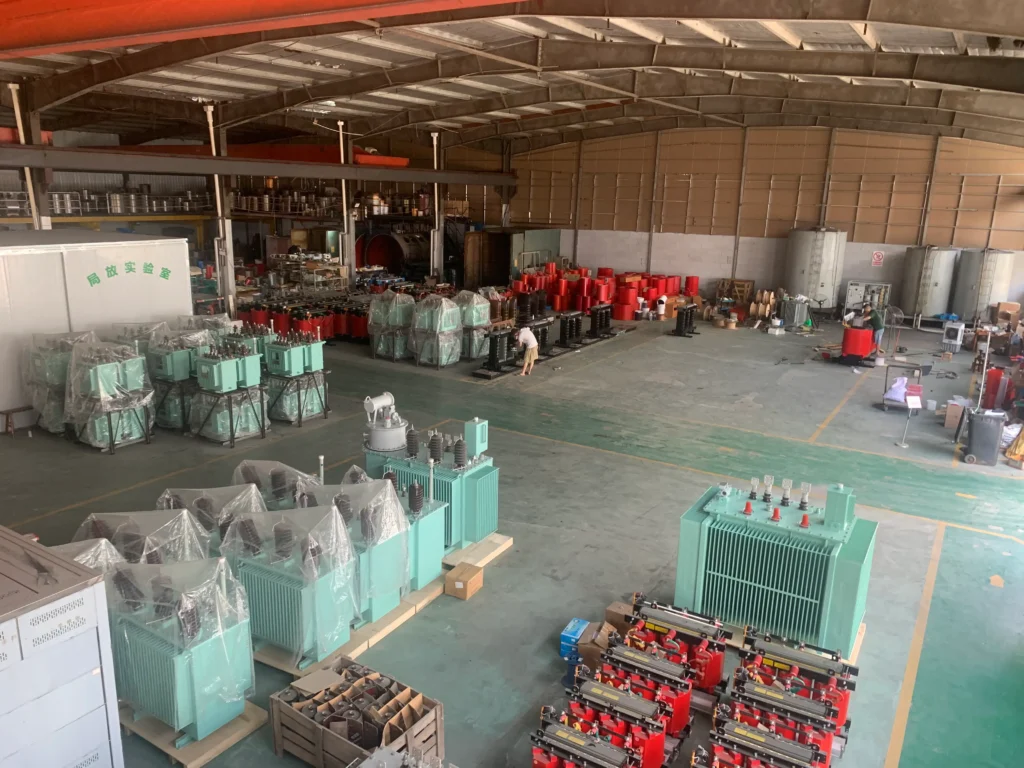
A quick tour of our production floor reveals what sets an expert factory apart from a basic assembly shop. As shown in our factory workshop photo, our facility combines automated coil winding, vacuum casting, and dedicated testing labs.
1. High-Grade Silicon Steel Core Stacking
We start with premium cold-rolled grain-oriented (CRGO) silicon steel sheets. Our engineers use a step-lap miter joint stacking technique. This precise layout significantly reduces core loss, lowers noise levels, and minimizes no-load currents.
2. Precision Resin Casting and Coil Winding
Our winding shop utilizes automated winding machines for exact turns ratio control. For cast resin transformers, copper or aluminum conductors are encapsulated under deep vacuum conditions. This process prevents void formation within the solid insulation matrix.
3. Partial Discharge Testing in Shielded Chambers
Partial discharge (PD) is the leading cause of internal insulation failure. In our workshop photo, you can see our specialized partial discharge laboratory (“局放实验室”). We test every transformer inside this shielded environment. We guarantee PD levels below 10 picocoulombs (pC), far exceeding industry standard requirements.
Critical Factors When Selecting Your Dry-Type Transformer Supplier
To ensure long-term ROI, buyers must evaluate more than just price quotes. Here are key core factors every procurement manager must review:
Insulation Temperature Class
Ensure your dry-type transformer supplier offers Class F (155°C) or Class H (180°C) insulation systems. Class H resin handles high overload capacities and withstands harsh thermal cycles without micro-cracking.
Enclosure Ingress Protection (IP Rating)
Indoor substation transformers typically use IP20 ventilated enclosures. For dusty industrial plants or coastal areas, choose IP23 or IP31 enclosures with filtered cooling fans and space heaters.
Energy Efficiency and Loss Standards
Modern power distribution mandates low loss levels. Verify whether your supplier complies with regional energy metrics such as the U.S. Department of Energy (DOE) efficiency standards. Lower no-load and load losses translate directly to thousands of dollars saved annually in operating costs.
Customized Engineering and OEM Capabilities
Every power installation presents unique spatial and electrical constraints. Experienced suppliers offer custom tap-changer configurations, top or bottom cable entry options, and integrated temperature monitoring controllers.
Key Advantages of Partnering with Baitong Electric
Baitong Electric is a professional dry-type transformer supplier committed to technical excellence and rigorous quality control. Our engineering team brings decades of experience to custom transformer manufacturing.
- Full Process Control: We handle core cutting, winding, resin casting, enclosure fabrication, and testing under one roof.
- Rigorous Testing Protocol: Every unit undergoes routine tests, partial discharge verification, and full dielectric withstand checks before dispatch.
- Global Compliance: Our products conform to ISO9001, CE, IEC, and ANSI standards for seamless international installation.
- Factory-Direct Pricing: By dealing directly with the original equipment manufacturer, you eliminate intermediary markups and receive dedicated engineering support.
Frequently Asked Questions (FAQ)
What is the lifespan of a cast resin dry-type transformer?
With proper maintenance and ambient temperature control, a high-quality cast resin dry-type transformer operates reliably for 25 to 30 years or longer.
What maintenance is required for a dry-type transformer?
Dry-type transformers require very little maintenance. Periodic visual inspections, removing surface dust build-up from cooling ducts, and checking connection torque are usually sufficient.
Can a dry-type transformer be installed outdoors?
Yes, but it requires a specialized weather-proof NEMA 3R or IP54 enclosure. The enclosure protects the windings from rain, UV radiation, airborne dust, and extreme temperature swings.