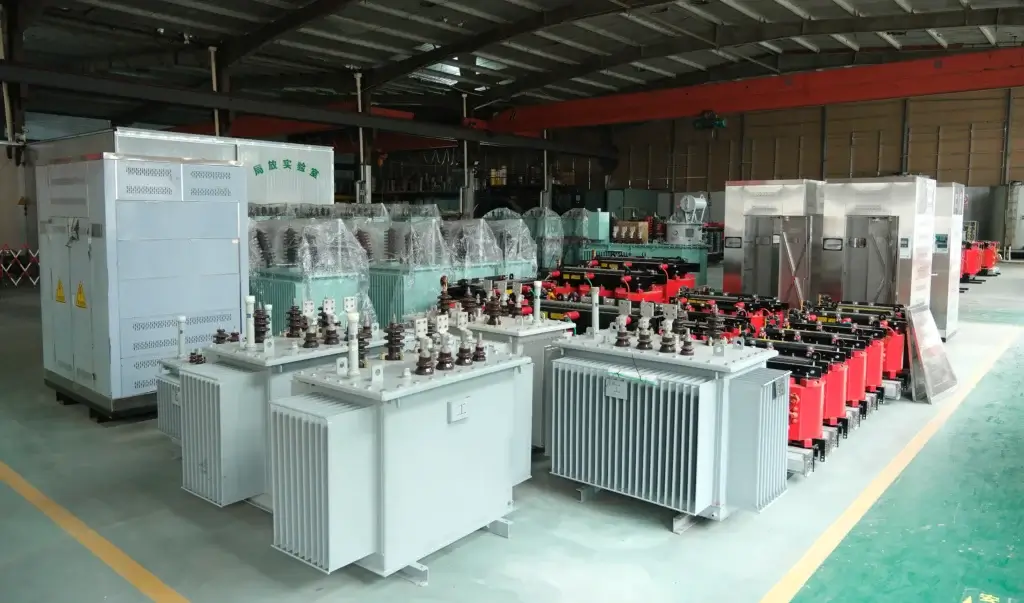
When a buyer asks us for a 15 kVA dry type transformer, we first request the complete voltage ratio and load information. The 15 kVA rating defines apparent power. It does not define the primary voltage, secondary voltage, phase, vector group, insulation level, or enclosure.
We use those details to prepare the electrical data sheet and outline drawing. Buyers can also review our resin-insulated dry-type transformer product family before sending an inquiry.
Start With Voltage, Phase, and Load
A 15 kVA dry type transformer can be built for different systems. One buyer may need a three-phase 10/0.4 kV distribution unit. Another may need a low-voltage isolation transformer. These orders do not use the same insulation design, terminals, tests, or dimensions.
Before we quote, we confirm:
- Primary and secondary voltage
- Single-phase or three-phase supply
- Rated frequency
- Vector group and neutral requirement
- Tapping range
- Impedance requirement
- Load type and operating duty
- Installation altitude and ambient temperature
- Required standard and test documents
For equipment up to 72.5 kV with at least one winding above 1.1 kV, IEC 60076-11 for dry-type transformers may be relevant. Its published scope excludes polyphase transformers rated below 15 kVA.
A three-phase unit rated exactly 15 kVA is not excluded by that capacity limit. However, the other scope conditions must still apply. We record the agreed standard in the quotation instead of assuming it from the capacity.
What the 15 kVA Rating Means in Practice
For a 15 kVA dry type transformer, the rated output current depends on voltage and phase. For a three-phase unit, we use this calculation:
Current = 15,000 ÷ (√3 × line voltage)
At 400 V, the nominal line current is about 21.7 A. At 480 V, it is about 18.0 A. These values help us select the winding, terminal connection, and internal leads. They also help the buyer coordinate cables and protective devices.
Capacity still needs to match the real load. We ask about motors, rectifiers, variable-frequency drives, heating loads, starting current, and operating hours. Harmonic current or repeated motor starts can change the design decision.
We do not apply one fixed spare-capacity percentage to every project.
How We Configure the Workshop Unit
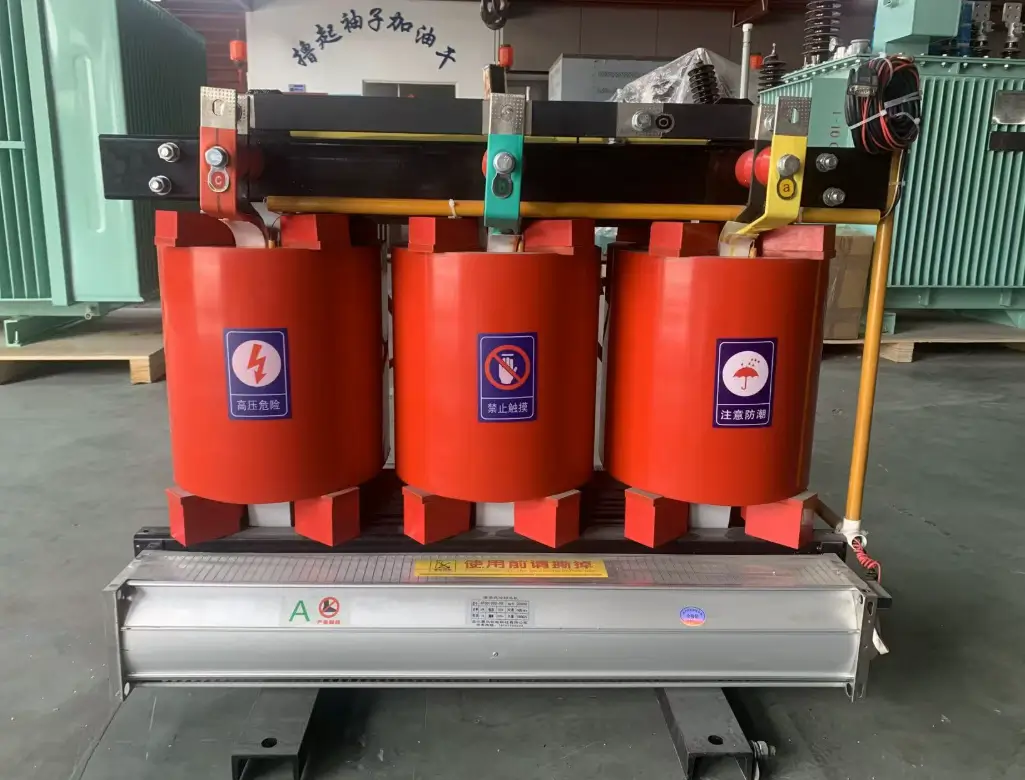
The factory unit used in this article is a three-phase open-frame assembly. It has three red resin-insulated windings and a black steel clamping structure. The top terminals have A, B, and C phase identification.
Safety labels are fitted to the winding surfaces. A cross-flow cooling assembly is mounted below the windings.
We do not use the visible fans alone to define the contractual cooling rating. Before production, the approved data sheet states whether the continuous rating is based on natural-air or forced-air cooling. It also states the fan control logic when a temperature controller is included.
The buyer must choose between an open-frame arrangement and a protective enclosure. We confirm the required IP level, ventilation openings, cable-entry direction, terminal clearance, and room layout.
For the 15 kVA dry type transformer, these mechanical details can be as important as the electrical rating.
The conductor material, insulation class, temperature-rise limit, loss values, and noise requirement are separate order items. We do not identify them from the coil colour or external appearance.
Factory Checks and Quotation Data
After the buyer approves the data sheet and drawing, our production team works to those documents. During assembly, we check:
- Winding position
- Clamping components
- Electrical clearances
- Phase identification
- Terminal joints
- Grounding points
- Specified accessory wiring
The test plan follows the contract and agreed standard. Typical routine checks can include winding resistance, voltage ratio, phase displacement, impedance, load loss, no-load loss, no-load current, and dielectric tests.
IEC 60076-1 provides general terminology and requirements for power-transformer specifications. We state the applicable tests in our offer instead of making a blanket compliance claim.
Before packing, we compare the finished unit with the approved drawing. We check its terminal arrangement, labels, fasteners, accessories, and visible surfaces. The coils and projecting terminals then receive protection against movement, impact, dust, and moisture during transport.
To quote a 15 kVA dry type transformer, please send the voltage ratio, phase, frequency, load type, enclosure requirement, installation conditions, quantity, and destination. A single-line diagram or existing nameplate is also useful.
Buyers can request a transformer quotation and attach the available project documents.
Frequently Asked Questions
How many amps can a 15 kVA three-phase transformer supply?
It supplies approximately 21.7 A at 400 V or 18.0 A at 480 V. The calculation must use the actual secondary line voltage.
Does a 15 kVA dry-type transformer always need cooling fans?
No. Cooling depends on losses, temperature rise, enclosure, ventilation, and site temperature. We record the natural-air or forced-air arrangement in the approved data sheet.
What information is required for a quotation?
Send the capacity, voltage ratio, phase, frequency, load type, vector group, impedance, enclosure, site conditions, required tests, quantity, and destination.