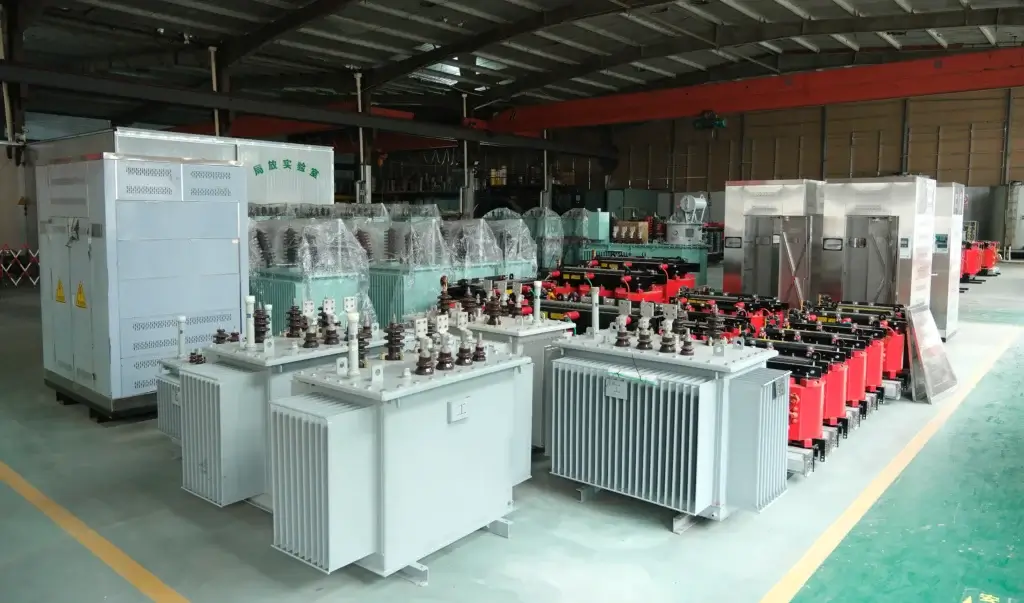
The SCB13-250/10-0.4KV is a 250 kVA dry-type distribution transformer with a nominal voltage ratio of 10/0.4 kV. It is intended to step medium-voltage electricity down to a low-voltage distribution level without using transformer oil.
The model number provides only the basic product identity. Frequency, vector group, impedance, losses, tapping range, temperature rise, enclosure, and accessories must still be confirmed with a cast resin dry type transformer manufacturer.
What Does SCB13-250/10-0.4KV Mean?
Under commonly used Chinese transformer model nomenclature, the designation normally indicates:
- S: three-phase transformer
- C: cast-resin dry-type insulation
- B: commonly refers to foil-winding construction
- 13: product series or performance-level designation
- 250: rated capacity of 250 kVA
- 10: nominal high-voltage rating of 10 kV
- 0.4: nominal low-voltage rating of 0.4 kV
Technical documents normally write the voltage unit as kV, although the supplied keyword uses KV.
For a three-phase 250 kVA unit operating at the nominal voltage, the calculated rated line current is approximately 14.4 A on the 10 kV side and 361 A on the 0.4 kV side. The manufacturer must confirm the final rated currents and terminal sizes.
The SCB13 designation does not automatically prove compliance with a particular efficiency class. Guaranteed loss values and applicable standards must be stated in the technical offer and verified by the test report.
Visible Construction and Applications
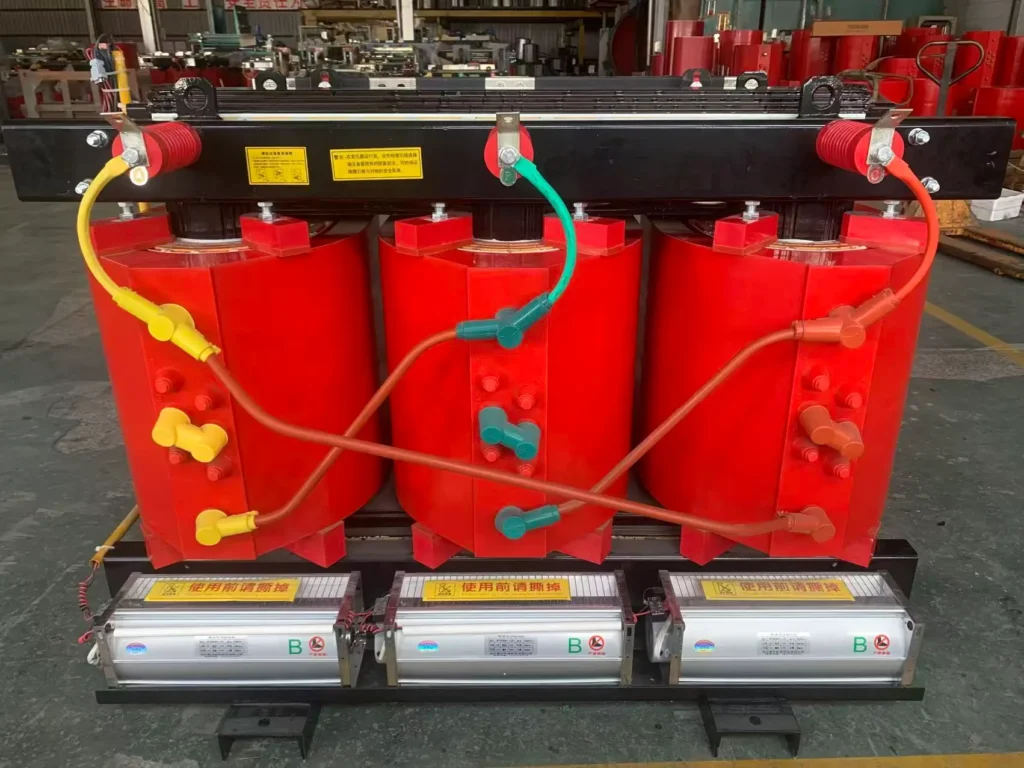
The photograph shows a completed three-phase cast-resin transformer assembly without its outer enclosure. Three red resin-insulated windings, colored phase connections, high-voltage tapping points, an upper steel clamping structure, insulated terminals, and three bottom-mounted cross-flow fans are visible.
These fans indicate that forced-air cooling provision is included in the photographed assembly. However, the available fan-assisted capacity, control settings, and operating mode cannot be determined from the image alone.
The open construction also provides a clear view of the SCB13-250/10-0.4KV active parts. During installation, the transformer may require a protective enclosure based on accessibility, ventilation, dust, moisture, and site-safety conditions.
Typical applications include:
- Commercial buildings
- Industrial factories
- Indoor substations
- Shopping and residential developments
- Data and communications facilities
- Infrastructure projects
- Renewable-energy systems
- Packaged substations
A dry-type transformer room must provide adequate ventilation and electrical clearances. Air inlets and outlets should remain unobstructed.
Technical Data to Confirm Before Ordering
Before purchasing an SCB13-250/10-0.4KV, provide the complete project specification rather than relying on the model number alone.
Electrical Requirements
Confirm:
- Rated frequency
- Vector group
- Percentage impedance
- High-voltage tapping range
- Tap step
- Insulation level
- No-load loss
- Load loss
- No-load current
- Temperature-rise limit
For an IEC-based project, buyers can refer to IEC 60076-11 for dry-type transformers. It addresses dry-type transformer requirements relating to dielectric and thermal performance, environmental conditions, climatic classification, fire behaviour, altitude, and enclosures.
Cooling and Installation
Specify whether the transformer will operate with natural-air cooling, forced-air cooling, or both. Do not assume the permissible fan-assisted loading increase. It must appear in the manufacturer’s approved data.
Provide:
- Maximum and minimum ambient temperature
- Installation altitude
- Humidity and contamination conditions
- Indoor or outdoor location
- Ventilation arrangement
- Required enclosure protection level
- Cable-entry direction
- Dimensional restrictions
Accessories
The required scope may include winding temperature sensors, a temperature controller, alarm and trip contacts, cooling fans, anti-vibration pads, surge arresters, an enclosure, and grounding provisions.
Only approved drawings and technical schedules define which accessories are included.
Manufacturing and Routine Testing
Production of the SCB13-250/10-0.4KV should control the core, windings, resin insulation, supports, connections, cooling system, and mechanical assembly.
Factory inspection should check winding surfaces, insulation distances, tapping connections, fastener tightness, phase identification, sensor wiring, grounding points, and fan installation. If an enclosure is ordered, its dimensions, ventilation, doors, locks, and cable openings must also be verified.
Applicable routine tests may include:
- Winding resistance measurement
- Voltage-ratio measurement
- Vector-group verification
- No-load loss and current measurement
- Load loss and impedance measurement
- Insulation tests
- Functional checks of sensors and fans
The buyer should request the technical data sheet, dimensional drawing, nameplate drawing, wiring diagram, accessory list, and routine test report before shipment.
Efficiency rules vary by destination and transformer classification. Equipment intended for the United States should be reviewed against applicable U.S. Department of Energy distribution transformer requirements before guaranteed loss values are finalized.
Frequently Asked Questions
Does the SCB13-250/10-0.4KV always use the same vector group?
No. The model code does not fully define the winding connection. Confirm the required vector group in the approved technical data sheet.
Do the cooling fans need to run continuously?
Not necessarily. Fan operation depends on the thermal design and temperature-control settings. Follow the manufacturer’s operating instructions.
Can this transformer be installed outdoors?
Outdoor installation may be possible with a suitable enclosure and environmental design. Protection level, ventilation, corrosion resistance, and site conditions must be specified.
The SCB13-250/10-0.4KV is a practical 250 kVA, 10/0.4 kV dry-type distribution transformer configuration. Final selection should be based on verified electrical ratings, loss requirements, cooling, enclosure design, accessories, and installation conditions.