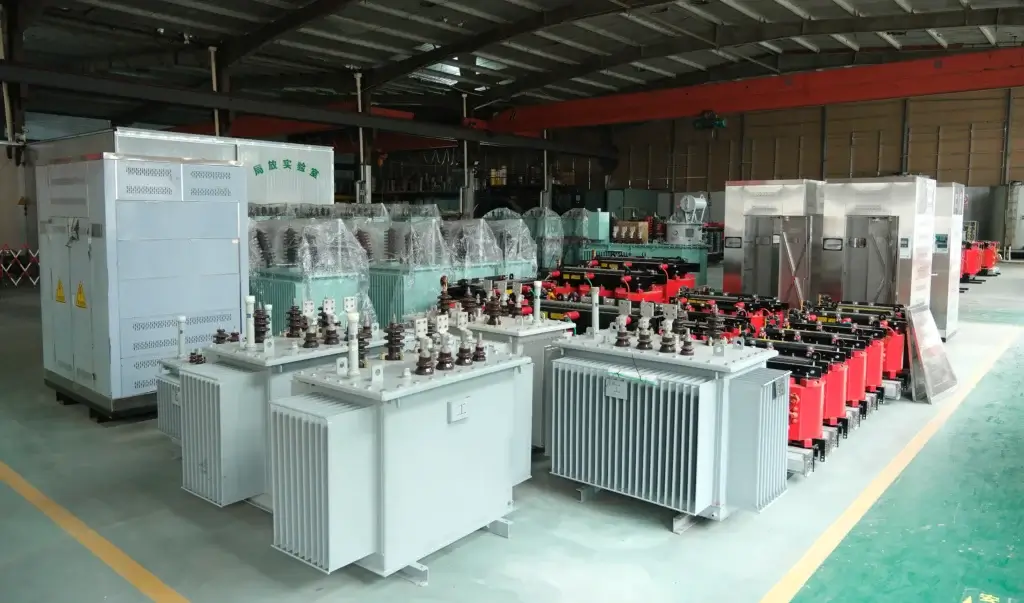
An oil immersed type transformer uses insulating oil to cool and electrically insulate its core and windings. It is widely applied in utility networks, industrial plants, commercial projects, renewable-energy systems, and outdoor substations.
Selecting the correct unit requires more than choosing a capacity from a catalogue. Buyers must also confirm the voltage ratio, impedance, loss values, tapping range, accessories, installation environment, and applicable standards. Working with an experienced oil immersed transformer manufacturer helps ensure these details are reviewed before production.
How Does an Oil Immersed Type Transformer Work?
The transformer’s active parts, including its core and windings, are installed inside an oil-filled steel tank. The oil provides electrical insulation and transfers heat from the active parts to the tank and cooling surfaces.
As the oil near the windings becomes warmer, it rises naturally. Cooler oil moves downward and replaces it. This circulation transfers heat without requiring a separate powered cooling system in many distribution applications.
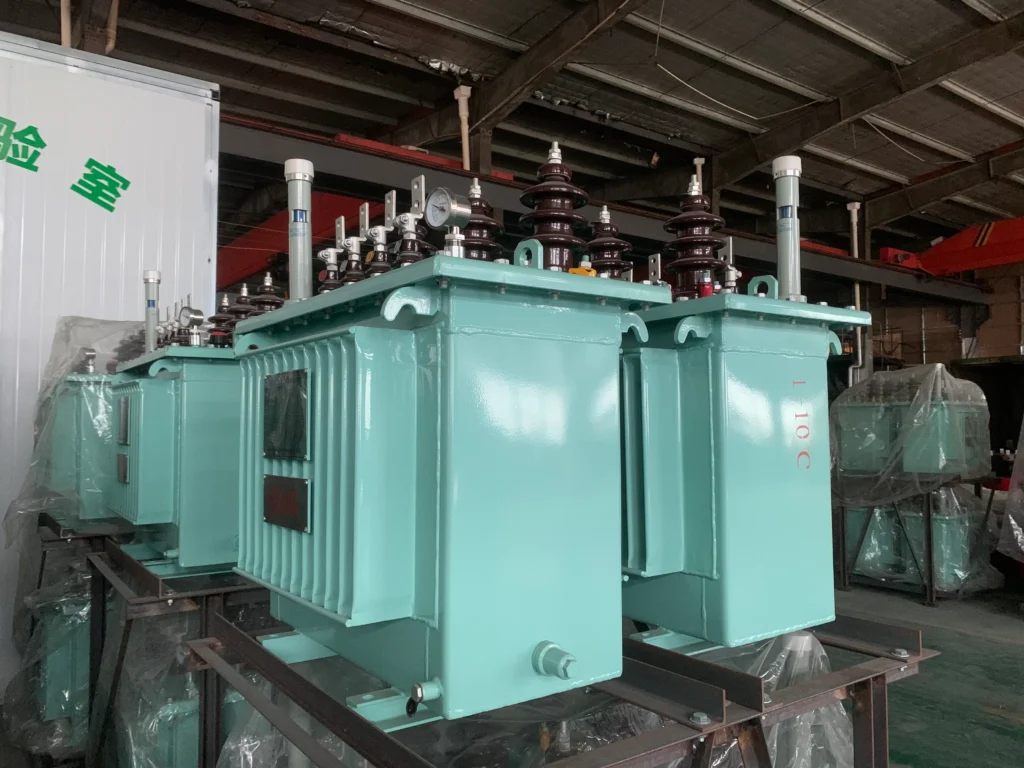
The factory photo shows several completed transformers with steel tanks, cooling surfaces, porcelain bushings, terminal connections, lifting points, pressure gauges, and other monitoring components. These visible features indicate units prepared for further inspection or project delivery. Their exact capacity and voltage cannot be confirmed because the nameplates are not readable in the image.
An oil immersed type transformer may use a sealed corrugated tank or a conservator-type arrangement. The correct construction depends on the transformer rating, oil expansion requirements, project specification, and local operating conditions.
Specifications to Check Before Ordering
A reliable quotation starts with complete technical information. Buyers should confirm the following items with the manufacturer.
Rated Capacity and Voltage
Specify the required capacity in kVA or MVA, primary voltage, secondary voltage, frequency, and number of phases. The expected operating load should also be stated. Continuous high loading and frequent load changes may influence the thermal design.
Vector Group and Impedance
The vector group defines the winding connection and phase displacement. Percentage impedance affects voltage regulation and short-circuit current. Both values must match the wider electrical system and protection design.
Tapping Range
Confirm the required tapping range, step percentage, and whether the project needs an off-circuit or on-load tap changer. An off-circuit tap changer must only be operated under the conditions stated by the manufacturer.
Losses and Temperature Rise
Ask the supplier to state the guaranteed no-load loss and load loss. These values affect the transformer’s lifetime operating cost. For projects subject to American regulations, buyers should compare the proposed values with the applicable U.S. Department of Energy distribution transformer requirements.
Temperature-rise limits, ambient temperature, altitude, and ventilation conditions must also be included in the specification. A standard design may need adjustment when installed at high altitude or in an unusually hot environment.
Applicable Standards
The purchase specification should clearly identify the required technical standard. IEC 60076-1 for power transformers covers general requirements for many three-phase and single-phase power transformers. Buyers should still confirm which IEC parts, national standards, utility specifications, or project-specific requirements apply.
Manufacturing and Testing Considerations
The performance of an oil immersed type transformer depends on control throughout manufacturing, not only on the final assembly.
Important production stages include core stacking, coil winding, insulation preparation, active-part assembly, drying, tank fabrication, oil treatment, filling, sealing, and routine testing. The manufacturer must also control moisture and contamination before the active part is placed in oil.
Tank welds and seals should be inspected for leakage. Bushings, terminals, gauges, valves, lifting points, and specified accessories must be checked against the approved drawing.
Applicable routine tests may include:
- Winding resistance measurement
- Voltage-ratio and vector-group verification
- No-load loss and no-load current measurement
- Load loss and impedance measurement
- Insulation tests
- Functional inspection of accessories
- Oil tests when required by the specification
The buyer should request a routine test report before shipment. For more detail on this production stage, see BTCN Electric’s transformer oil filling process.
Buyer’s Checklist for an Accurate Quotation
When requesting an oil immersed type transformer quotation, provide:
- Required capacity and quantity
- Primary and secondary voltages
- Frequency and number of phases
- Vector group
- Percentage impedance
- Tapping range and tap-changer type
- Maximum ambient temperature
- Installation altitude
- Indoor or outdoor installation
- Cooling method
- Required loss and temperature-rise limits
- Applicable standard
- Required accessories
- Destination and delivery terms
Site information is especially important. The manufacturer should know whether the transformer will operate in a coastal area, dusty location, high-humidity environment, extreme temperature, or restricted installation space.
Buyers should also confirm terminal orientation, cable entry, overall dimensions, wheel arrangement, lifting method, paint requirements, and packaging before approving the production drawing.
Price comparisons should be based on the same technical scope. A lower quotation may exclude essential accessories, special testing, protective devices, shipping preparation, or required loss performance.
Frequently Asked Questions
What is the main purpose of transformer oil?
Transformer oil provides electrical insulation and transfers heat from the core and windings to the tank and cooling surfaces. Its quality and condition are important to reliable operation.
Can an oil-immersed transformer be installed indoors?
It may be possible, but the installation must follow local fire, ventilation, drainage, oil-containment, and building requirements. A dry-type transformer may be more suitable for some indoor locations.
What documents should a buyer request?
Buyers should normally request the approved technical data sheet, dimensional drawing, accessory list, nameplate drawing, routine test report, packing information, and operation instructions.
An oil immersed type transformer should be selected according to the complete electrical system and actual installation conditions. Send BTCN Electric your technical specification, single-line diagram, or existing transformer nameplate for configuration review and quotation.