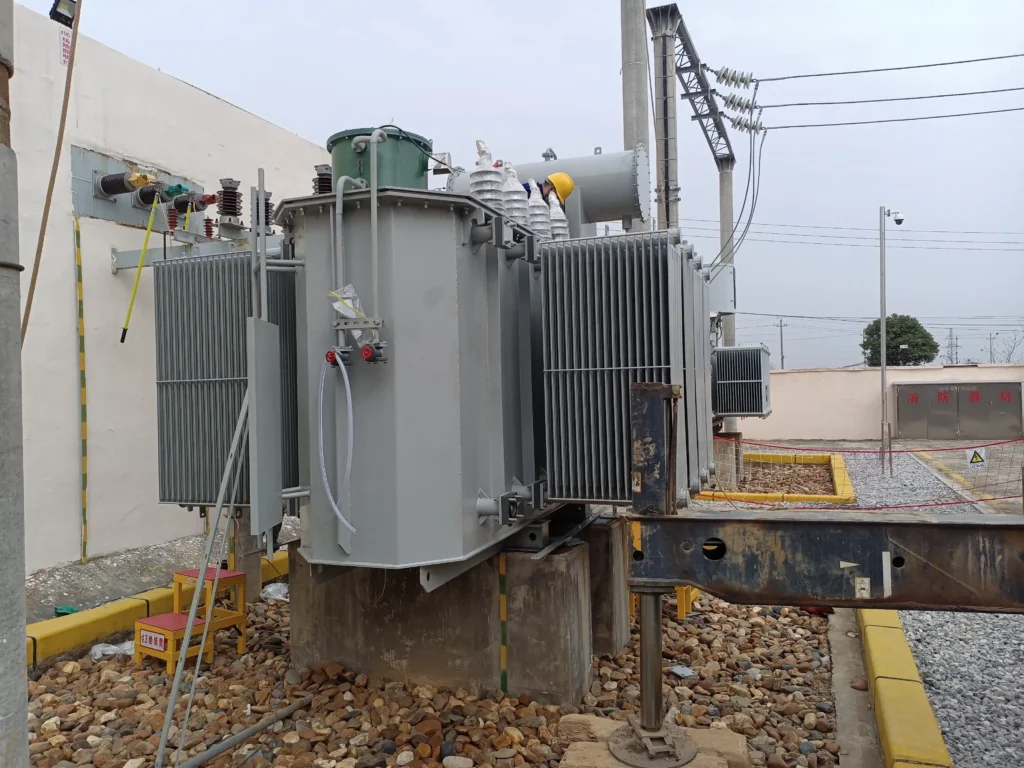
The heavy lifting is officially over. Look at the foreground of the latest site photograph. You can see the steel outrigger of the mobile crane. It just lowered this heavy-duty unit into place. This moment is crucial for EPC contractors. Logistics end, and electrical commissioning begins.
Here, an oil immersed self cooled transformer proves its worth. Remote outdoor nodes cannot rely on maintenance-heavy equipment. Such equipment is a major liability. That is why this specific unit dominates the site. It relies entirely on thermodynamics, not mechanical parts. This guarantees decades of silent power distribution. Let’s examine the physical realities in this photo. We will see why this design is the ultimate choice.
The Physics of Reliability: The ONAN System
The grey corrugated radiator banks are visually striking. They flank the massive main tank. These are not merely protective steel panels. They form the core of the thermal management system.
An oil immersed self cooled transformer lacks circulating pumps. It does not force dielectric fluid through the core. There are no external electric fans bolted to the radiators. The system relies on the principles of natural convection. International engineering standards call this the ONAN cooling class.
Copper windings generate intense heat under electrical load. The surrounding mineral oil absorbs this thermal energy. This heated oil naturally decreases in fluid density. It then rises to the top of the main tank. The oil flows outward into the top radiator headers. Ambient outdoor air washes over the steel surface area. This cools the oil and increases its density. The cooler oil naturally sinks to the bottom header. It then cycles right back into the magnetic core.
This means zero moving parts for the EPC contractor. There are no fan motors to burn out. There are no pump impellers to replace ever. It requires zero parasitic power to keep it cool. This is maintenance-free thermal engineering at its finest.
Civil Engineering Meets Heavy Equipment
Substation deployments often face site alignment issues. Civil and electrical teams must coordinate perfectly. Look closely at the bottom of the photograph. The transformer does not rest on a flat slab. It is mounted on elevated concrete plinths. It hovers over a dedicated stone catchment pit.
This is a non-negotiable safety standard. Any high-capacity oil immersed self cooled transformer needs this. The unit contains hundreds of gallons of flammable fluid. The site must be ready for worst-case scenarios. A tank rupture could dump burning oil. The fluid would fall directly into the rocks below.
The cold gravel acts as an instant thermal quench. It breaks up the fluid flow immediately. It chokes off the oxygen supply to stop flames. The oil then drains into an underground containment system. This protects the surrounding electrical substation from destruction. It also prevents hazardous environmental soil contamination. Baitong Electric provides footprint schematics months in advance. Your civil team can pour these plinths perfectly.
Top-Side Commissioning and Fluid Management
Now, shift your focus to the top of the unit. You can see our field technician up there. He wears a yellow hard hat for safety. He is navigating the tight spaces near the bushings. Working at this elevation requires strict spatial clearances. Maintenance crews must safely access these diagnostics later. They cannot breach the live arc-flash boundaries.
The green cylindrical tank is the conservator. An oil immersed self cooled transformer uses natural flow. However, the total oil volume still expands and contracts. Ambient temperatures and grid loads fluctuate daily. The conservator acts as an expansion chamber. It features a highly engineered dehydrating breather. The transformer “breathes” outside air during cooling cycles. This breather blocks all moisture from entering. The internal dielectric fluid remains completely dry.
Bridging the Gap Between Factory and Field
Procuring heavy electrical equipment is not just reading data sheets. The fabricated metal must actually work on your site. Every component in this photograph reflects field realities. The jacking pads rest perfectly on the concrete. The lifting lugs accommodated the massive crane. The radiator spacing allows proper natural airflow.
Does your project demand rugged reliability? You need an oil immersed self cooled transformer. You need a partner who understands the field. Baitong Electric bridges the factory and the substation. Reach out to our engineering desk today. Let us review your single-line diagrams together.