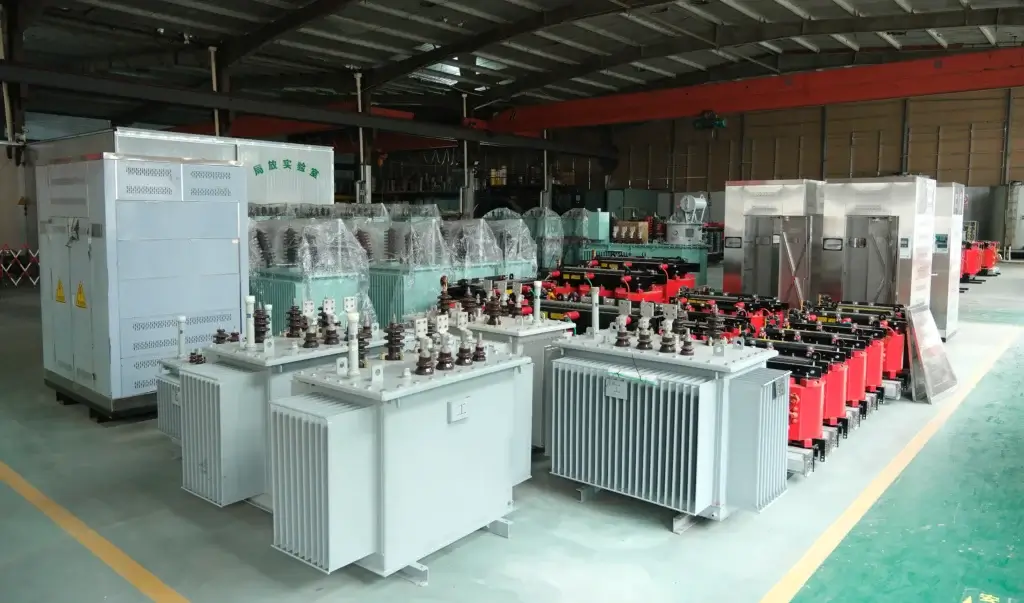
When a buyer requests a cast resin dry type transformer, our work starts with the electrical data and installation plan. The red coils are only one visible part of the product. Rated capacity, voltage ratio, vector group, impedance, taps, loss requirements, cooling, enclosure, and terminal layout all affect the finished unit.
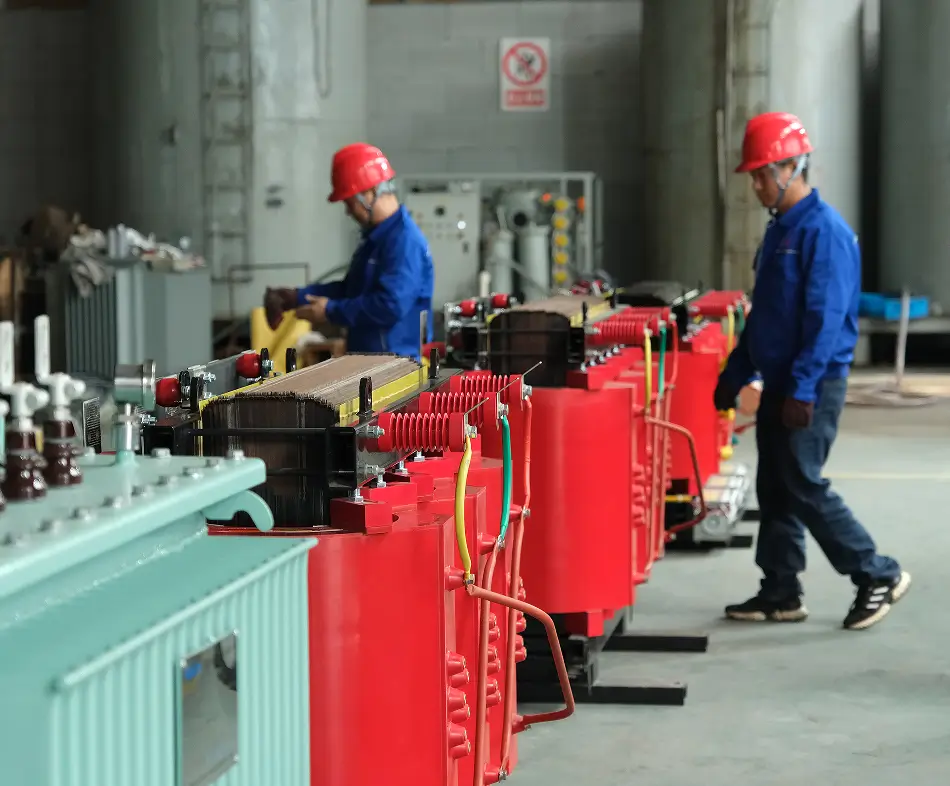
The factory image shows a row of dry-type assemblies in our workshop. Red cast coils, laminated cores, insulators, connection conductors, and steel bases are visible. Two technicians in safety helmets are working beside the units. This is an assembly and inspection stage, not a display of finished shipments.
Buyers can review our cast resin dry type transformer range or send us their project specifications for a factory quotation.
What We Build in Our Cast Resin Product Line
In a cast resin design, the high-voltage winding is enclosed in solid resin insulation. The design does not use transformer oil as its main insulation and cooling medium. This changes the installation requirements, especially for room ventilation and fire-safety coordination.
For our SCB product family, we use epoxy resin casting for the high-voltage coils. The winding is reinforced as part of the insulation structure. Our listed low-voltage construction uses copper foil with interlayer insulation.
The final conductor, insulation class, temperature-rise limit, and loss values are recorded in the approved technical data. We do not determine these details from appearance alone.
A cast resin dry type transformer can be supplied as an open unit or with an enclosure. Temperature sensors, controllers, cooling fans, cable boxes, busbar interfaces, and other accessories depend on the order.
Before production, we confirm which items are included. We also place the terminal direction, cable entry, enclosure dimensions, and base details on the drawing sent to the buyer.
From Approved Drawings to Workshop Assembly
Our technical review comes before material preparation. We ask for the rated capacity, primary and secondary voltage, frequency, vector group, impedance, tapping range, and applicable loss requirements.
Site altitude, ambient temperature, humidity, ventilation, and load profile are also important. These conditions can affect the insulation, cooling, enclosure, and overall arrangement.
After the data is approved, production follows the confirmed drawing and work instructions. Coil dimensions, insulation arrangements, connection positions, and support points must match the design.
The high-voltage coils pass through controlled casting and curing stages before final assembly. Each cast resin dry type transformer moves to assembly after the main production data has been released.
During core-and-coil assembly, our team positions the windings around the core. We then install the supporting and clamping components. Leads and phase connections are routed according to the drawing.
The units in the photograph remain open. This gives our technicians access to the core, coils, terminals, and base structure.
At this stage, we check:
- Core and coil alignment
- Insulation clearances
- Clamping components and fasteners
- Phase markings
- Lead routing
- Terminal positions
- Earthing points
- Base dimensions
- Visible surfaces
An enclosure and final accessories are added later when they form part of the contract.
Factory Checks and Order Documents
A factory photograph shows the production environment, but the agreed documents define the product. Before release, we compare the transformer with the approved data sheet, drawing, and inspection plan.
The electrical test scope is confirmed with the buyer. Depending on the order, it can include:
- Winding resistance
- Voltage ratio
- Vector group
- No-load loss
- Load loss
- Impedance
- Applied-voltage tests
- Induced-voltage tests
- Accessory function checks
Special tests or witnessed inspections must be requested before production scheduling. This allows us to include the correct procedure, documentation, and inspection time in the order.
For IEC-based projects, buyers can consult IEC 60076-11 for dry-type transformers when preparing their technical and testing requirements. The applicable edition and any local requirements should be stated in the inquiry.
For overseas orders, we also confirm the required document package. It can include:
- Approved drawings
- Technical data sheets
- Routine test reports
- Nameplate information
- Packing lists
- Accessory lists
- Installation documents
This prevents missing documents from delaying site acceptance.
Before packing, we protect the exposed coils, terminals, and connection components from impact, dust, and moisture. The transformer is secured through its steel base. Packing is selected according to the transport route and expected storage conditions.
Selecting the Correct Product Configuration
The correct cast resin dry type transformer is not selected by kVA alone. It must match the electrical system and the room in which it will operate.
Buyers should tell us whether the project uses cables, busbars, or bus duct. We also need the incoming and outgoing direction.
Available space, lifting access, ventilation openings, and service clearances should be checked before the enclosure drawing is approved. If the room has restricted airflow, that information must be provided during the quotation stage.
Loss requirements depend on the target market and project specification. For projects intended for the United States, buyers should review the applicable U.S. Department of Energy distribution transformer requirements before approving efficiency and loss values.
For a complete quotation, send us:
- Rated capacity and voltage ratio
- Frequency and number of phases
- Vector group, impedance, and taps
- Required loss and temperature-rise limits
- Cooling and temperature-control requirements
- Enclosure and protection requirements
- Cable or busbar connection details
- Site altitude and ambient conditions
- Quantity and destination
- Required drawings and test documents
With this information, we can prepare a technical proposal instead of offering a generic model. Buyers can then compare the product scope, drawings, test plan, and price on the same basis.
If you are sourcing a cast resin dry type transformer, send us your available specification. Our team will identify any missing technical details before preparing the quotation.
FAQ About Cast Resin Dry Type Transformers
What information should I send before requesting a quotation?
Send the capacity, voltage ratio, frequency, vector group, impedance, taps, loss limits, installation conditions, enclosure, connection method, and quantity. A single-line diagram is also useful.
Does every cast resin transformer require cooling fans?
No. The cooling arrangement depends on the rating, thermal design, enclosure, room ventilation, and load profile. We confirm natural-air or fan-assisted cooling in the approved data sheet.
Can BTCN change the enclosure and terminal direction?
Yes. We review the enclosure size, protection requirement, cable entry, busbar interface, terminal side, and base dimensions before releasing production. The approved drawing records the final arrangement.