Building a heavy-duty substation unit on our factory floor is only half the battle. The real test begins the moment the crane lowers the equipment onto the site. At Baitong Electric, we constantly remind EPC contractors that strict adherence to oil filled transformer installation requirements is the only way to guarantee a 30-year operational lifespan and avoid disastrous commissioning failures.
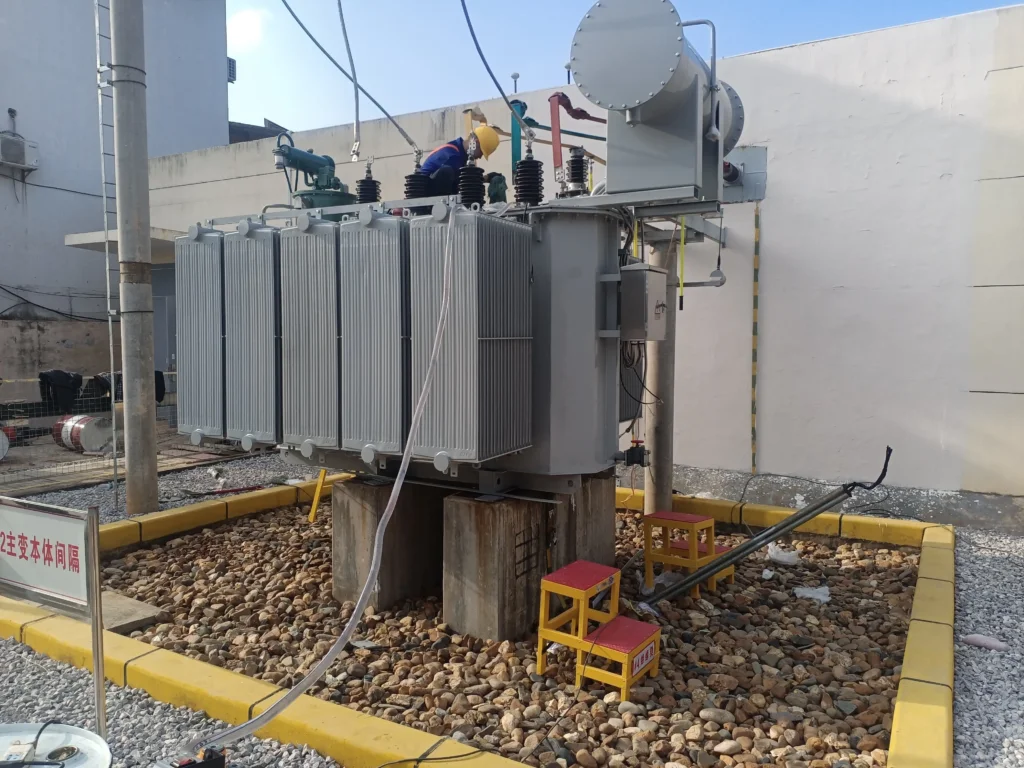
Take a look at the recent site photo above from one of our standard 35kV deployments. It perfectly illustrates what a compliant, safe, and professional setup should look like before the grid is energized.
The Foundation and Oil Containment Strategy
Notice that the unit isn’t resting on a flat slab. It is elevated on solid concrete plinths, positioned directly over a thick bed of coarse gravel. This is not for aesthetics.
Meeting international oil filled transformer installation requirements means planning for worst-case scenarios. That gravel pit serves as a critical secondary spill containment and fire-quenching system. In the extremely rare event of a tank rupture, the river stones rapidly cool the leaking mineral oil, preventing it from pooling and catching fire, while safely draining it into an underground catchment basin. If your civil engineering team ignores this step, your site will fail its safety inspection.
Spatial Clearances for Maintenance and Safety
Look at our technician performing the final hardware checks near the conservator tank and high-voltage bushings at the top. Working at this elevation requires rigorous spatial planning.
Standard oil filled transformer installation requirements dictate specific phase-to-ground clearances and safe working zones. The layout must factor in the physical swing of incoming overhead cables during high winds. Furthermore, components that require regular checks—like the silica gel breather and the Buchholz relay—must be positioned so maintenance crews can access them without accidentally breaching the safety distance of live high-voltage lines.
Thermal Management: Give the Radiators Room to Breathe
The massive corrugated radiator banks you see mounted on the sides of this unit are engineered for maximum ONAN (Oil Natural Air Natural) cooling efficiency.
To preserve the internal oil’s dielectric strength, those fins must dissipate immense heat continuously. Because of this, oil filled transformer installation requirements explicitly forbid constructing blast walls, acoustic barriers, or security fencing too close to the radiator banks. If you starve the transformer of natural airflow, the winding temperatures will spike, triggering the thermal protection relays and shutting down your entire power supply.
Site Prep is Not an Afterthought
We’ve seen too many projects delayed because the site foundations didn’t match the equipment footprint. Understanding oil filled transformer installation requirements long before the truck arrives is what separates amateur setups from professional power grids.
Are you sizing a new substation and need structural drawings to prep your civil works? Skip the middlemen and talk directly to the source. Contact the engineering desk at Baitong Electric today, and let’s get your site ready for power.