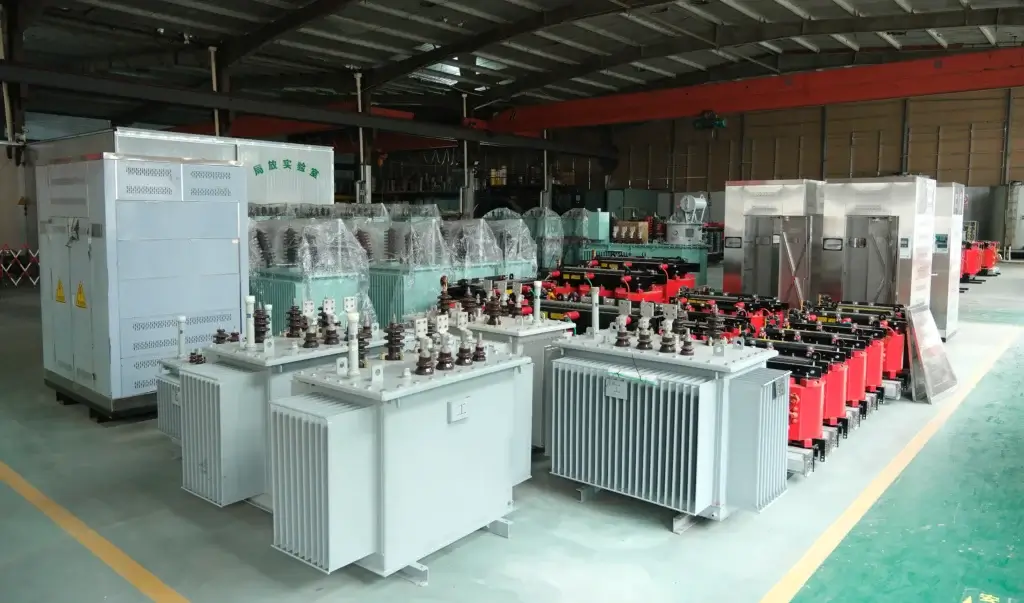
Compared to oil-filled transformers, dry-type transformers share the same operating principle, but the most significant difference lies in the presence or absence of oil inside the transformer; there are also many other distinctions.
- In terms of appearance, the enclosure types differ: the core and windings of a dry-type transformer are visible, whereas only the outer casing of an oil-filled transformer is visible;
- The lead-out configurations differ: dry-type transformers mostly use silicone rubber bushings, while oil-filled transformers mostly use porcelain bushings;
- Capacity and voltage ratings differ: dry-type transformers are generally suitable for distribution applications, with capacities typically below 1,600 kVA and voltages below 10 kV, though some models can reach the 35 kV voltage level; oil-filled transformers, however, can cover the full range of capacities from small to large and support all voltage levels; The 1,000 kV ultra-high-voltage test line currently under construction in China will undoubtedly utilize oil-filled transformers.
- Insulation and cooling methods differ. Dry-type transformers generally use resin insulation and rely on natural air cooling; larger capacities may use fan-assisted cooling. In contrast, oil-filled transformers rely on insulating oil for insulation, with the oil circulating inside the transformer to carry heat generated by the windings to the radiator fins for dissipation.
- In terms of application settings, dry-type transformers are mostly used in locations requiring “fireproofing and explosion-proofing,” and are generally preferred for large-scale and high-rise buildings; oil-filled transformers, however, may cause oil spray or leakage in the event of an “accident,” potentially leading to fires, so they are mostly used outdoors and in locations where space is available to install an “accident oil sump.”
- They differ in load-bearing capacity. Generally, dry-type transformers should operate at their rated capacity, whereas oil-immersed transformers have better overload capacity.
- Cost differences: For transformers of the same capacity, the purchase price of dry-type transformers is higher than that of oil-immersed transformers.
Oil-immersed transformers use oil as the primary insulation medium and rely on oil as the cooling medium (natural convection, forced air cooling, or water cooling). The main transformers in substations are generally oil-immersed.