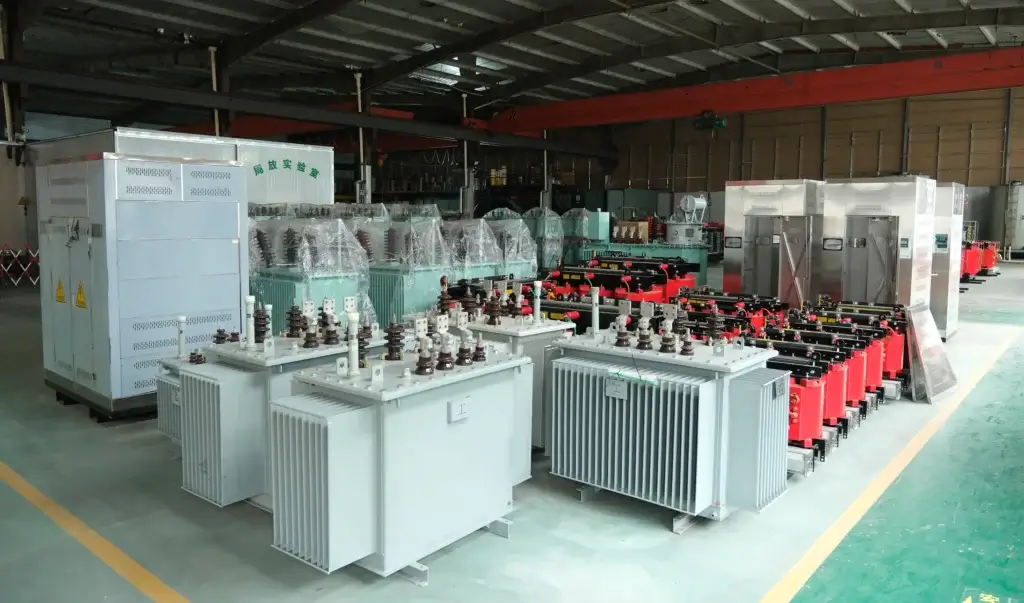
Buying a 400 kVA oil-immersed transformer for Saudi Arabia or the UAE starts with one question. Not price. Frequency.
Saudi Arabia runs at 60 Hz. The UAE runs at 50 Hz. One unit cannot serve both markets. Two further differences follow: the medium-voltage level and the pollution level at the site.
This guide sets out an order that works. Fix frequency first, then voltage, then losses. Price comes last, and by then the comparison is fair.

50 Hz or 60 Hz: Decide This First
Frequency sets the flux in the core. The relation is short. At fixed voltage, flux falls as frequency rises.
A 50 Hz design running at 60 Hz sees flux drop to about 83%. The core stays clear of saturation. No-load loss falls a little. The unit is safe, but the core is larger than the duty needs. You paid for iron you will never use.
The other direction is the dangerous one. A 60 Hz design running at 50 Hz sees flux rise by roughly 20%. The core moves toward saturation. No-load current climbs, no-load loss climbs, and temperature rise follows.
So a unit built for Riyadh should never be installed in Dubai. That is not a rule of thumb. It is a consequence of E=4.44fNΦ.
Put the frequency on the enquiry, the purchase order, the nameplate and the test certificate. A supplier who treats 50 and 60 Hz as a labelling detail is doing one of two things. He is over-building the unit, or he is shaving the design margin. Both outcomes are paid for by the buyer.
There is a commercial edge here. A design properly optimised for 60 Hz can use a smaller core and less iron. That saving belongs to the buyer who specifies frequency correctly. Ask for core mass in both designs, and the difference becomes visible.
Grid Conditions in Saudi Arabia and the UAE

The table carries the facts that do not move. Everything else comes from the purchaser’s specification.
Two notes matter commercially. A 33 kV primary needs a higher insulation level than an 11 kV primary. Tank clearances, bushings and oil volume all grow with it. Two units of the same rating at different primary voltages are not the same price, and a quotation that ignores this is not comparable.
Low-voltage nominal values are quoted differently in the two markets. Confirm the figure and its tolerance band on the utility specification, and write both into the order.
Some Saudi specifications also call up 34.5 kV at the primary. Read the primary voltage on the tender, not on a map.
The UAE figures come from DEWA tender documentation, which specifies 11/0.4 kV at 50 Hz.
Treat the Saudi medium-voltage level as a site fact rather than a national one. Confirm it against the utility specification before you order.
Where a 400 kVA Oil-Immersed Transformer Fits
400 kVA sits inside the preferred rating series of IEC 60076-1. It appears in the distribution range of both markets, which is why it is ordered so often.
At a power factor of 0.8, this rating carries about 320 kW. Continuous loading in the 60 to 75 percent band is commonly cited as a comfortable working range. That leaves headroom for motor starting and for a few years of load growth.
Three applications suit the rating. A building substation serving several floors. A small industrial plant with a handful of drives. A pumping or irrigation load, where duty is steady and the site is remote.
One 400 kVA or Two 200 kVA
This is the decision buyers tend to skip. Two 200 kVA units give N-1 redundancy. Lose one and half the load still runs. The price is doubled no-load loss, doubled footprint and doubled circuits.
One 400 kVA unit costs less to buy and less to run at light load. It also has a single point of failure.
The choice turns on the cost of an outage, not on the price of the unit. A data room and a workshop answer that question differently.
What to Specify Before You Ask for a Price
Six items decide both the price and the suitability of a 400 kVA oil-immersed transformer. Confirm all six before you compare quotations.

One note on losses. Loss figures for a Gulf project usually sit in the utility specification, not in a brochure. A supplier who quotes a loss value without asking for that specification is guessing. A buyer who compares two quotations without checking the loss basis is comparing two different machines.
Temperature rise belongs in the same conversation. State the site ambient first, then state the rise you will accept.
How the Unit Is Built
A 400 kVA oil-immersed transformer is a small machine with the same six parts as a large one.
The core is wound from grain-oriented silicon steel and laminated to limit eddy currents. The windings sit over the core limbs, in copper or aluminium. The tank and radiator hold the oil and provide the cooling surface. Bushings carry the conductors through the tank wall at the insulation level the system needs. The tap changer is off-circuit at this rating, usually with five positions. Protection covers a pressure relief device, a gas relay, and oil and winding temperature indicators.
Each part is sized by the duty, not by habit. Our oil-immersed distribution transformers page covers the wider range, and the process detail sits in our manufacturing article.
Heat, Dust and Coastal Air
Three site conditions separate a Gulf installation from a European one. None of them is a marketing point. All three belong in the technical agreement.
Why 40 °C Is the Wrong Assumption
IEC 60076-2 sets temperature rise limits against a reference ambient. The reference is a maximum of 40 °C, a daily average of 30 °C and a yearly average of 20 °C.
Gulf sites exceed the first figure for months at a time. Solar radiation on the tank adds more. The standard is still met, and the unit still runs hot.
Two routes exist. Specify a reduced temperature rise, or accept a derating. Either way, write the choice into the contract. A transformer that meets the standard and overheats on site has met the standard, and that will not help you.
Dust on the Radiator Is a Derating Event
ONAN cooling depends on natural convection over the radiator fins. Dust blocks the air path. The thermal calculation behind the rating assumes clean fins.
A site with a monthly dust cycle is not that site. Put fin cleaning into the maintenance schedule, and price it as a service item rather than an afterthought. Where the layout allows, place the unit out of the prevailing wind-blown sand.
Salt, Dust and Creepage
Coastal sites combine salt, dust and humidity. IEC 60815 turns that combination into a pollution level, and the level drives bushing selection.
A standard bushing on a coastal site will track and flash over. Ask the buyer to state the pollution level, then order bushings to match it.
Oil oxidation also runs faster in high ambient. Shorten the oil sampling interval to suit, rather than following a template written for a temperate site.
Against a Dry-Type Unit at This Rating
At 400 kVA both technologies are viable. The question is not whether a 400 kVA oil-immersed transformer is better. It is whether the room can take oil at all.

Indoors, inside a building, with fire rules and no space for oil containment: dry-type. Outdoors, dusty, cost-sensitive, with room for a radiator: oil-immersed.
Resin-insulated units are covered on our dry-type transformer page. The cost mechanics behind the price gap are a separate subject.
Certification and Utility Approval
Certification has three layers. Most buyers discover only the first.
Layer One: Saudi Clearance
Regulated products entering Saudi Arabia pass through SABER, which issues a Product Certificate and a Shipment Certificate. Whether a specific transformer model falls inside a technical regulation is a question for the importer or the notified body. Do not take a supplier’s word for it (SASO and SABER process).
Layer Two: UAE Clearance
The UAE operates ECAS, administered by MoIAT, for products covered by a technical regulation (MoIAT service page). The same caution applies. Scope depends on the regulation, not on the product family name.
Layer Three: Utility Approval
This is the real gate. DEWA, ADDC, SEC and Aramco each keep their own specification, their own type-test requirements and their own approved vendor list. A certificate moves the unit through customs. It does not move it onto a tender.
So ask two separate questions. Can you clear customs, and are you approved by the utility? A supplier who answers the first and dodges the second has told you what you need to know.
Installation and Maintenance
Installation follows a fixed order. Skip a step and the unit sits on site without entering service.
Civil works come first. The foundation must carry the operating mass, and cable trenches must be laid before the unit arrives. Lifting comes next, on the designated lugs only. A tank lifted on a sling is a tank with a distorted wall.
Oil handling follows. Units shipped oil-less need vacuum treatment on site. Moisture left in the insulation is the most common cause of a failed commissioning test. Accessories then go back on, and the tank is pressure-tested at the joints before anything is energised.
Acceptance tests run last: insulation resistance, ratio, winding resistance and oil dielectric strength. Add a settling period after filling. Air bubbles trapped in the oil will trip a gas relay that is working correctly.
Maintenance is a short list, and it is short on purpose. Oil level and leaks. Oil sampling on the interval set for high ambient. Bushing cleaning. Fin cleaning. Earthing and protection checks. Each item costs an hour and prevents a failure with a much larger bill.
What Fails in the First Year
Most early failures are not design failures. They are installation and environment failures, and they repeat across sites.
Gasket leaks. Flanges loosened by the first thermal cycles weep oil at the joint. Retorque after the first month in service, then again after the first hot season.
Moisture in the oil. Oil-less shipment plus a rushed vacuum leaves water in the insulation. Dielectric strength drops before any other symptom appears. Test the oil before energising, not after.
Blocked radiator fins. Dust loading cuts cooling capacity without changing any reading on the panel. The first sign is a rising top-oil temperature at unchanged load.
Tap changer left between positions. An off-circuit switch has to sit on a detent. Half engagement heats the contact and carbonises the oil around it.
Bushing flashover on coastal sites. Salt and dust build a conductive path that a standard creepage distance does not resist. This is a specification error, not a maintenance error.
Each item above has a cheap check and an expensive cure. The checks belong in the commissioning file, and the file belongs with the unit.
FAQ
Can one unit work on both 50 Hz and 60 Hz?
Not safely in both directions. A 50 Hz unit will run at 60 Hz, but the core is oversized for the duty. A 60 Hz unit on 50 Hz will run hot and may saturate.
Should the transformer ship oil-filled or oil-less?
Short sea routes and small units usually travel oil-filled. Long routes and awkward handling favour oil-less, with vacuum filling on site.
Which loss figures apply in the Gulf?
The ones in the utility specification for that project. Where an efficiency regulation applies, that sets the ceiling.
How do I choose the bushing pollution level?
From the site, using IEC 60815. Coastal Gulf sites sit in the heavy bands, and standard bushings are not enough.
Does a 400 kVA unit need derating at 50 °C ambient?
Usually yes, unless the order specifies a reduced temperature rise. Decide this before the contract, not after commissioning.
What is the typical lead time?
It depends on the design freeze date, the test station queue and the vessel schedule. Ask for a dated plan, not a number of weeks.